FDA-Compliant Sunscreen Sticks: The Science Behind HAESKN's Clear SPF
By Eugene Kim, Product Lead (ex-Estée Lauder). Formulation reviewed by Julio Pina, cosmetic chemist.
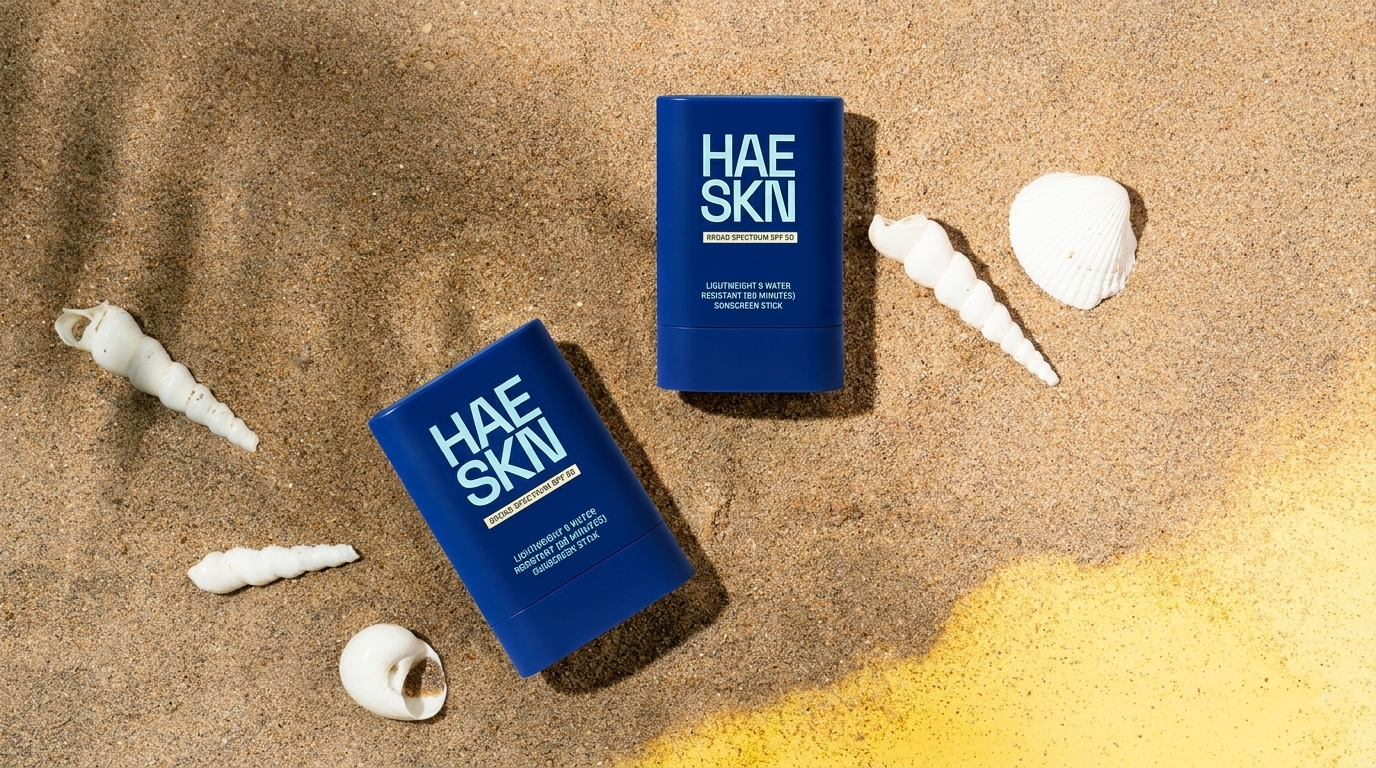
Short answer: HAESKN's SPF 50 Sun Stick is a compliant US over-the-counter (OTC) sunscreen. It uses only filters permitted by the FDA OTC sunscreen monograph (avobenzone, homosalate, octisalate, and octocrylene), is manufactured in the US under drug-level CGMP, and is tested for SPF 50, broad spectrum, and 80-minute water resistance per FDA protocols. It delivers a clear, lightweight K-beauty finish without the white cast of mineral formulas.
For athletes who want K-beauty texture with US regulatory certainty, here is what actually sits behind the label.
"FDA-approved" vs "FDA-compliant": the distinction that matters
In the US, sunscreen is regulated as an OTC drug, not a cosmetic. Every active ingredient, SPF number, and water-resistance claim has to meet FDA standards before the product can be sold legally.
Sunscreens sold under the OTC monograph are not individually approved by the FDA the way a prescription drug is. Instead, the manufacturer has to:
- Use only permitted active ingredients at allowed concentrations
- Pass FDA SPF testing (in vivo, on human subjects)
- Pass broad-spectrum testing (critical wavelength at least 370 nm)
- Pass water-resistance testing for any 40- or 80-minute claim
- Manufacture under drug CGMP (21 CFR Parts 210/211)
- Label to Drug Facts panel rules
So the accurate phrase is "FDA-compliant," not "FDA-approved." HAESKN meets every item on that list. If a brand tells you its sunscreen is "FDA approved," that wording is itself a warning sign, because monograph sunscreens do not receive individual approval.
The filters HAESKN uses, and why they stay US-legal
The FDA monograph permits a fixed set of UV filters. HAESKN's stick uses four of them:
- Avobenzone: the most common UVA filter in US sunscreens. Absorbs UVA (320–400 nm) but is photounstable on its own.
- Octocrylene: stabilizes avobenzone and absorbs UVB.
- Homosalate: UVB filter that raises SPF and helps the formula spread.
- Octisalate: UVB filter that improves water resistance and texture.
Paired together, these four are photostable, so the formula does not break down quickly in sunlight the way avobenzone would alone. The stick carries them in a wax matrix with film-forming polymers, which helps them hold to skin through sweat and water.
Here is the part worth understanding. Many sunscreens formulated for the Korean or European market use newer filters such as bemotrizinol (Tinosorb S) or bisoctrizole (Tinosorb M). Those filters were not part of the US monograph until bemotrizinol was approved in June 2026, so imported formulas built around them are not sold as compliant US OTC sunscreens. HAESKN is formulated with US-permitted filters, which is why it ships as a standard US OTC drug while keeping a K-beauty texture. You get the finish without the regulatory gap.
Clear, lightweight, no white cast
Mineral sunscreens (zinc oxide and titanium dioxide) sit on the skin surface and scatter visible light, which is what leaves a white cast, especially on medium to deep skin tones. Research from UCLA found that conventional zinc oxide particles clump and scatter light into a chalky residue.
Chemical filters absorb UV and convert it to heat, and they blend into the skin instead of sitting on top. That is what removes the white cast and allows a fast-absorbing texture. For anyone reapplying mid-run or between padel sets, that texture is the difference between actually reapplying and skipping the second coat. More on that choice in our guide on whether the HAESKN stick is mineral or chemical.
Are chemical filters safe?
The FDA published studies in 2019 and 2020 (in JAMA) showing that several chemical filters, including avobenzone, homosalate, octisalate, and octocrylene, can be absorbed through skin into the bloodstream above 0.5 ng/mL after a day of use, with some detectable for weeks.
What that finding means in practice: the FDA asked for more safety data. It did not find harm, and it did not ban these filters. The American Academy of Dermatology still recommends broad-spectrum SPF 30+ and does not advise avoiding chemical filters. The European Commission's Scientific Committee on Consumer Safety reviewed homosalate and oxybenzone in 2021 and recommended lower maximum concentrations because of possible endocrine effects. HAESKN's stick does not contain oxybenzone or octinoxate, the two filters that draw the most scrutiny.
For scale, bemotrizinol, the first new US filter in over two decades (approved June 2026), went through more than $18 million of safety testing over twenty years: a two-year animal study with no cancer signal, a multigenerational reproductive study with no harm to offspring, and irritation tests it passed at permitted concentrations. Its large molecule barely absorbs, staying below the 0.5 ng/mL plasma threshold. The older filters in HAESKN's stick have decades of use with no affirmative finding of harm. The "needs more data" label reflects the FDA's chronic-use drug standard, not a safety alarm.
How the SPF 50 and water-resistance claims get tested
Every SPF and water-resistance claim on a US sunscreen has to be backed by FDA-defined testing. In brief:
SPF 50 is measured on human subjects at a 2 mg/cm² dose under a solar simulator, comparing protected to unprotected skin. SPF 50 blocks about 98% of UVB. Going higher adds almost nothing, which is why the FDA caps label claims. We break down what that number really means for training in what SPF 50 means for athletes.
Broad spectrum requires a critical-wavelength test at 370 nm or above, which is what lets a product legally claim it reduces skin cancer and aging risk, not just sunburn. Full explainer in our broad spectrum and PA ratings guide.
80-minute water resistance is the FDA's highest allowed claim, tested across four 20-minute water immersion cycles with SPF measured afterward. HAESKN's stick carries the 80-minute claim. No sunscreen can legally say "waterproof," because all of it eventually washes off, which is why reapplication matters more than any single number. Our guide on whether sweat washes off sunscreen covers the field side of that.
Formulation oversight: Julio Pina
HAESKN's advisor Julio Pina is a cosmetic chemist and formulator focused on UV filter chemistry and product stability. On HAESKN's stick, his work included choosing the four-filter combination for photostability and broad-spectrum coverage, tuning the wax matrix so the stick glides and adheres through sweat, and overseeing stability testing across the product's shelf life while the US facility met CGMP requirements.
His brief was specific: keep the lightweight, clear, skincare-forward feel that defines Korean sunscreen texture, but build it entirely on US-permitted filters and US drug manufacturing. That is the combination the finished stick is meant to deliver.
Why the stick format is the real compliance story
The most common reason a sunscreen underperforms is not the SPF number. It is that people apply too little and reapply too rarely. Dermatology research consistently finds that most people use a quarter to half of the 2 mg/cm² dose that SPF is tested at, so real-world protection often lands well below the label. Reapplication is worse. Once you are outside, mid-match or mid-run, a lotion asks you to find clean hands, a mirror, and a few minutes to let it absorb. Most people skip it.
That gap is what the stick format is built to close. HAESKN put its SPF 50 into a stick, not a tube, because the format is the adherence mechanism. One hand, no mirror, no mess, and it goes on straight over sweat. It fits in a running belt or a padel bag, so reapplication is a ten-second swipe at a water break instead of a chore you talk yourself out of. The clearest, most photostable formula does nothing if it is sitting in your bag. A stick you actually reapply beats a lotion you applied once at the car.
That is the through-line of the product: FDA-permitted filters for regulatory certainty, a clear chemical formula for no white cast, and a stick format so the protection survives contact with real sport.
How HAESKN compares
| Feature | HAESKN SPF 50 Stick | Typical US Chemical Sunscreen | Typical US Mineral Sunscreen |
|---|---|---|---|
| Active filters | Avobenzone, homosalate, octisalate, octocrylene | Often includes oxybenzone or octinoxate | Zinc oxide, titanium dioxide |
| White cast | None (clear chemical formula) | None | Often visible on deeper skin tones |
| Texture | Lightweight, fast-absorbing | Varies, can feel heavy | Thick, sits on the surface |
| Water resistance | 80 minutes | 40–80 minutes | 40–80 minutes |
| Reapplication | One-hand stick | Hands or spray | Hands, can pill over makeup |
| Photostability | Stabilized by octocrylene | Varies | High |
HAESKN's stick is built for athletes who reapply often in high-sweat, high-UV conditions. The stick format means you are not touching your face with sweaty or sandy hands, and the clear formula does not streak on skin or gear.
What to check on any sunscreen stick
- Broad-spectrum claim on the label (UVA and UVB)
- Water resistance (80 minutes is the ceiling; reapply after sweat or towel drying)
- SPF 50 (blocks 98% of UVB; higher adds little)
- A clear chemical formula if white cast is a dealbreaker
- A photostable pairing (avobenzone with a stabilizer like octocrylene)
- A Drug Facts panel, which confirms it is regulated as a US OTC drug
HAESKN's stick meets all six.
FAQ
Is HAESKN's sunscreen stick FDA approved?
More precisely, it is FDA-compliant. It uses only FDA-permitted active ingredients (avobenzone, homosalate, octisalate, octocrylene), is made in the US under drug-level CGMP, and is tested for SPF 50, broad spectrum, and 80-minute water resistance. Monograph sunscreens are not individually approved by the FDA; they have to meet the monograph's testing and labeling standards, which HAESKN does.
Are chemical sunscreens safe?
The FDA, the American Academy of Dermatology, and the EU's Scientific Committee on Consumer Safety all treat chemical filters as safe for general use. The FDA's 2019–2020 studies showed some filters are absorbed into the bloodstream, but absorption is not the same as harm, and the FDA asked for more data rather than issuing a ban. HAESKN's stick leaves out oxybenzone and octinoxate, the two most-scrutinized filters.
Why doesn't HAESKN use bemotrizinol?
The stick was formulated before bemotrizinol was approved in the US in June 2026. Its current four-filter blend is already photostable, broad-spectrum, and compliant. A future formula could add the new filter as it becomes commercially available.
How does HAESKN differ from Korean sunscreens sold overseas?
Many sunscreens made for the Korean or European market use filters such as bemotrizinol or bisoctrizole that were not in the US monograph, so those formulas are not sold as compliant US OTC sunscreens. HAESKN uses US-permitted filters, so it ships as a standard US OTC drug while keeping the K-beauty finish.
What does "80-minute water resistant" mean?
The stick keeps its labeled SPF after 80 minutes of water immersion, tested to FDA protocol. Reapply after swimming, heavy sweat, or towel drying, and at least every two hours in extended sun.
Can I use the stick on my face?
Yes. It is made for face and body. The clear formula does not leave white streaks, which is part of why it holds up over sweat and under a cap or visor.
Bottom line: HAESKN's SPF 50 Sun Stick gives you a clear, lightweight K-beauty finish on a fully US-compliant OTC drug foundation: permitted chemical filters, drug-level US manufacturing, and SPF 50, broad-spectrum, and 80-minute water-resistance testing. For athletes who want the feel of Korean sunscreen with US regulatory certainty, that pairing is the point.
If you want a stick built for lightweight chemical-filter performance in daily and sport use, the HAESKN SPF 50 Sun Stick ships from the US.