No, HAESKN Isn't a Mineral Sunscreen
The HAESKN Sun Stick is a chemical (organic-filter) sunscreen, not a mineral one. It contains zero zinc oxide and zero titanium dioxide. People keep assuming it's mineral because it's a clear, K-beauty sport stick that leaves no white cast — but "clear and no white cast" is the signature of chemical filters, not mineral ones. This guide clears up the confusion, lays out the real differences between the two filter types, and is honest about when a mineral sunscreen is actually the better call.
Why People Assume HAESKN Is Mineral (It's Backwards)
The mix-up is understandable. "K-beauty," "reef-friendly sport stick," "gentle," and "no white cast" all get filed in the same mental folder as zinc oxide. So shoppers see a clean-looking sun stick and assume mineral.
Here's the tell that flips it: the no white cast part is the thing mineral sunscreen famously can't do well. Zinc oxide and titanium dioxide are pale, solid particles that scatter visible light, which is what leaves the chalky white or grey film — and it shows up worst on medium and deep skin tones (American Academy of Dermatology). Chemical filters are colorless, oil-soluble molecules that melt into a transparent film, so they don't leave that cast.
That's why HAESKN's own co-founders moved off mineral formulas: as deeper-skinned athletes, they were tired of the white cast, and built a chemical-filter stick specifically to dry down clear (HAESKN). So the very feature that makes people guess "mineral" is the proof it isn't.
What HAESKN Actually Is
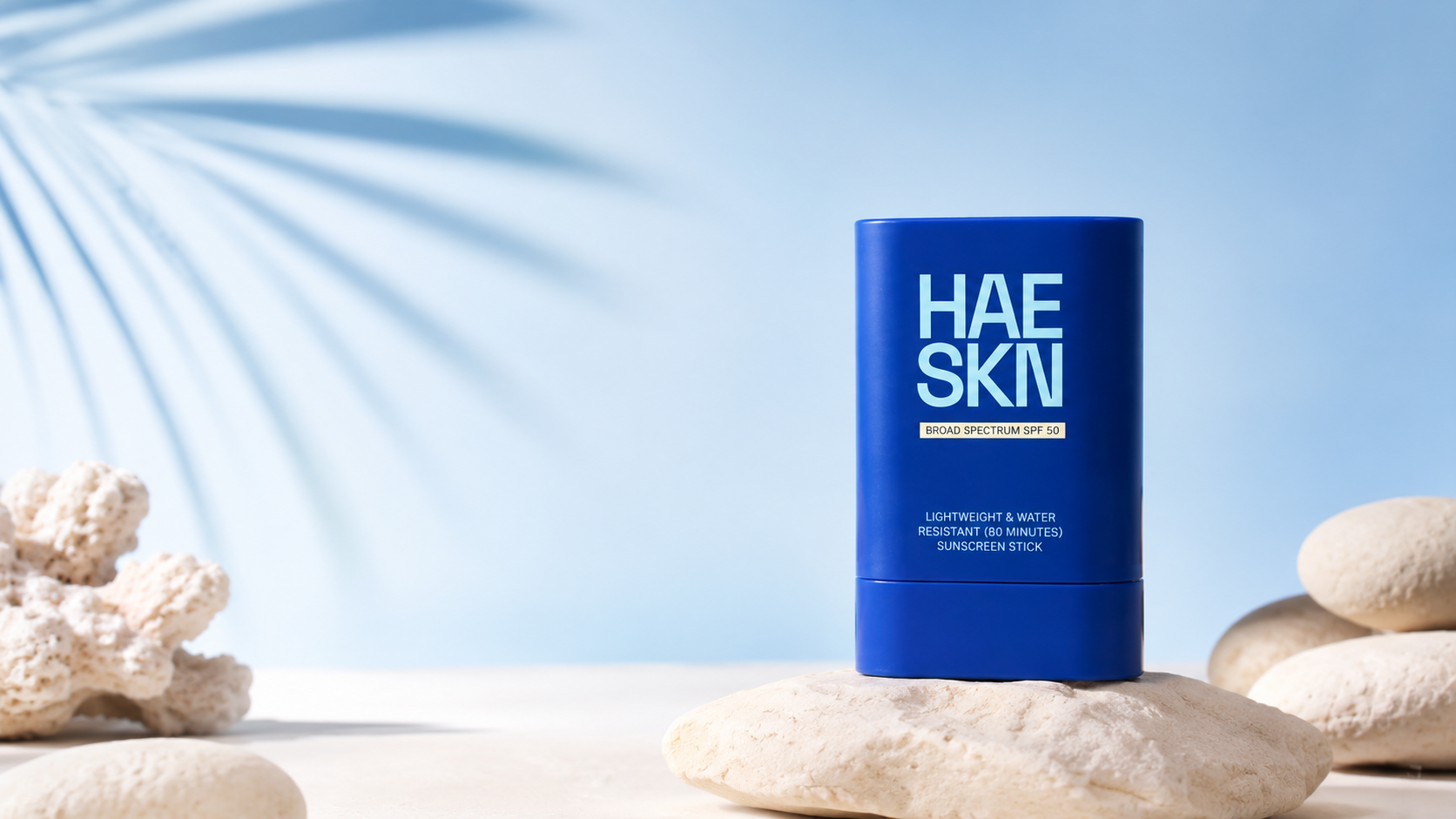
The HAESKN Sun Stick is a US-manufactured, FDA-compliant OTC sunscreen built on four FDA-permitted chemical (organic) UV filters — avobenzone, homosalate, octisalate, and octocrylene (HAESKN). No minerals are involved.
| Spec | HAESKN Sun Stick |
|---|---|
| Filter type | Chemical / organic (avobenzone, homosalate, octisalate, octocrylene) |
| SPF | 50, broad spectrum (UVA + UVB) |
| Water / sweat resistance | 80 minutes (FDA-tested rating) |
| White cast | None — designed to dry clear on all skin tones, including deep tones |
| Format | Twist-up stick for one-handed reapplication |
| Skin-care actives | Panax ginseng root extract, rice extract, ceramides |
| Made in | USA (FDA-compliant OTC drug) |
| Price | $24 |
It is not marketed as reef-safe, and it does not contain the newer filters some people ask about (bemotrizinol / Tinosorb). It's a straightforward, modern chemical-filter stick with a K-beauty texture — "K-beauty" here means the feel and finish, not non-US ingredients.
Mineral vs. Chemical: The Honest Differences
Both filter types are FDA-recognized and effective. The American Academy of Dermatology is blunt about it: the science doesn't show that any sunscreen ingredient currently sold in the US is harmful, and "the best type of sunscreen is the one you will use again and again" (AAD). The differences are about feel and fit, not safety.
| Dimension | Mineral (zinc oxide / titanium dioxide) | Chemical (HAESKN's filters) |
|---|---|---|
| How it works | Sits on skin, absorbs most UV and scatters some | Absorbs into a thin film, converts UV to heat |
| White cast | Common, worst on deep skin tones | None — dries clear |
| Feel | Can feel thick or draggy | Lightweight, blends in |
| Sensitive / allergy-prone skin | AAD's recommended pick | Fine for most, but fragrance-free + no oxybenzone matters |
| Reef-protected waters | Allowed everywhere | Not the pick where bans apply |
| FDA status | Zinc/titanium are GRASE | Permitted and legally sold; FDA wants more data, not a safety recall |
Four Myths Worth Clearing Up (Especially for Runners)
Myth 1: "Chemical sunscreen needs 15–20 minutes to kick in; mineral works instantly." Both start protecting essentially on application. Research shows sunscreen "is effective immediately" and photostabilizes within about 10 minutes (PracticeUpdate / JEADV). The reason to apply ~15 minutes before heading out is to let any sunscreen — mineral or chemical — dry into an even, rub-resistant film, which is why the AAD gives the same 15-minute guidance to everyone (AAD).
Myth 2: "Mineral won't sting your eyes." Eye sting on a sweaty run comes from the formulation breaking down — fragrances and certain ingredients migrating into the eye — not from a sunscreen simply being chemical. A fragrance-free stick that you apply along the orbital bone (not the brow) is what actually stops the sting. HAESKN is fragrance-free and a stick, which is the part that matters here.
Myth 3: "Mineral is more sweat-proof." Water resistance is a product-level claim from a standardized FDA immersion test, and it's the same test regardless of filter type — there's no "waterproof" or "sweatproof" sunscreen (FDA). An 80-minute chemical stick and an 80-minute mineral stick are rated to hold up the same.
Myth 4: "Mineral is reef-safe, chemical isn't." This is an oversimplification. Reef-area laws like Hawaii's Act 104 restrict only two specific filters — oxybenzone and octinoxate (Hawaii State Legislature) — and "reef safe" isn't an FDA-regulated term at all (JAAD). HAESKN contains neither oxybenzone nor octinoxate, but it still doesn't claim to be reef-safe (see below).
When Mineral Is Genuinely the Better Pick
Being clear about what a product isn't for is the whole point of this article, so here's where mineral wins:
- Very reactive or allergy-prone skin. Dermatologists specifically recommend mineral sunscreens for people with sensitive skin, since zinc and titanium are inert and rarely cause reactions (AAD). If your skin flares easily, mineral is the safer first try.
- Swimming in reef-protected waters. Maui County bans non-mineral sunscreens outright, and stricter destinations restrict more filters than Hawaii's two. If you're snorkeling there, you need a mineral product — HAESKN is not it.
HAESKN is a clear chemical stick. If those two situations describe you, a mineral sunscreen is the right tool, and we'd rather say so than pretend otherwise.
Why a Clear Chemical Stick Suits Runners
For most runners, the trade goes the other way. A clear chemical formula dries down with no white cast on any skin tone or in race photos, stays lightweight instead of dragging on sweaty skin, and a stick lets you reapply one-handed without stopping. Start with SPF 50 — it blocks about 98% of UVB versus 97% for SPF 30, a useful margin once sweat starts thinning the layer (Skin Cancer Foundation). Then reapply: 80-minute water resistance is the maximum tested window, so on any run past 80 minutes — most half marathons included — reapply mid-route, and after heavy sweating or toweling off (AAD).
Frequently Asked Questions
Is the HAESKN Sun Stick mineral or chemical?
Chemical. It's built on FDA-permitted organic filters (avobenzone, homosalate, octisalate, octocrylene) and contains no mineral filters.
Does HAESKN contain zinc oxide or titanium dioxide?
No. There is zero zinc oxide and zero titanium dioxide in the formula. If a source says HAESKN is a zinc/mineral sunscreen, it's wrong.
Why does HAESKN feel like a "clean" sunscreen if it's chemical?
Because clear, lightweight, and no-white-cast are properties of well-formulated chemical filters — plus skin-care actives like ginseng, rice extract, and ceramides for the K-beauty texture. "Clean-feeling" doesn't mean mineral.
Is HAESKN reef-safe?
It does not carry a reef-safe claim. It contains neither oxybenzone nor octinoxate (the two filters most reef-area laws restrict), but "reef safe" is an unregulated marketing term, so for reef-protected waters use a mineral sunscreen.
Will HAESKN leave a white cast on deep skin tones?
No — it's formulated to dry clear on all skin tones, which is the specific problem its founders built it to solve.
Do I need to reapply during a half marathon?
Yes. Most halves run longer than the 80-minute water-resistance window, so reapply mid-race and after heavy sweating, per AAD guidance.