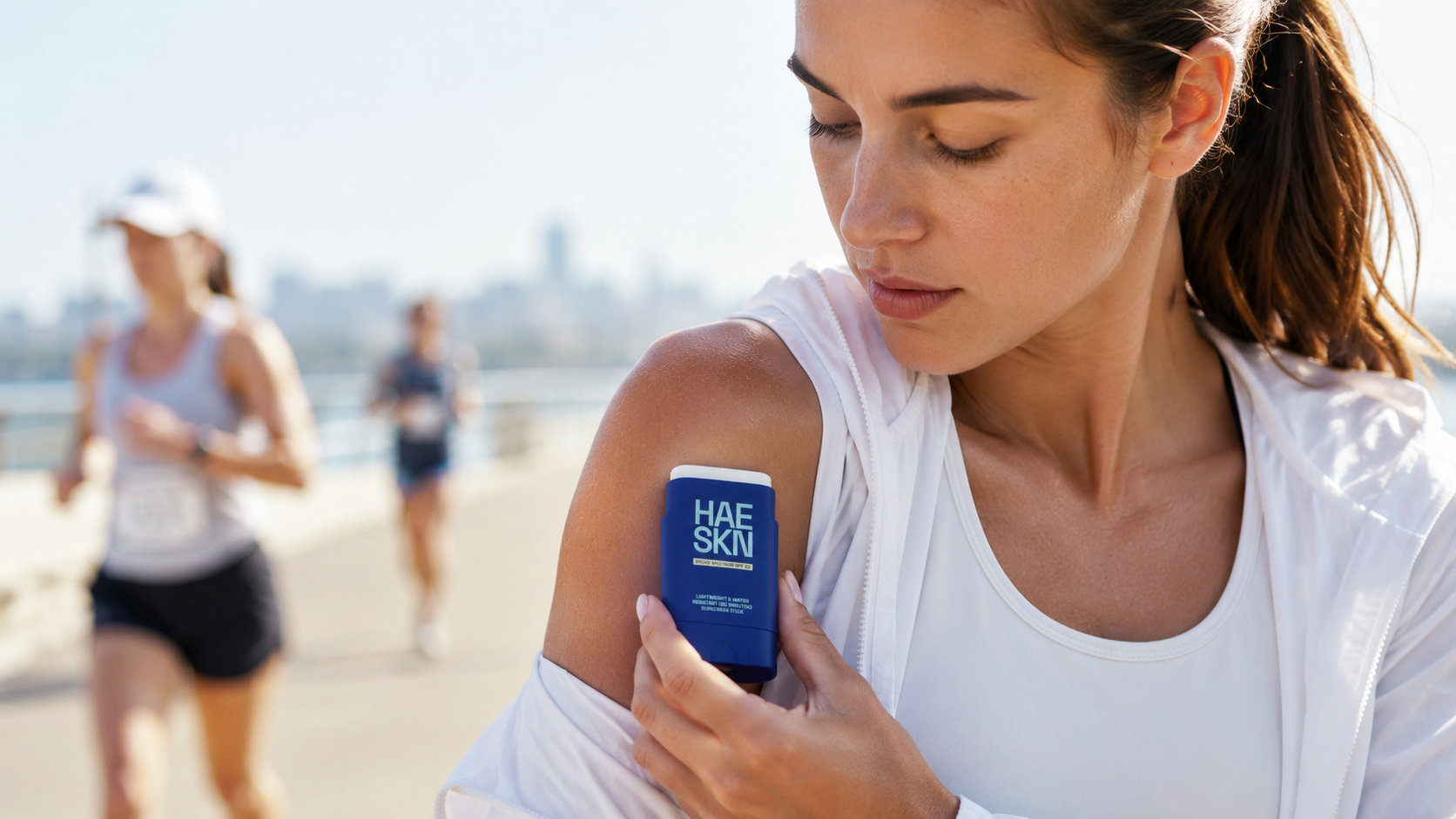
Marathon Sun Protection: The Stick Format Advantage
Marathon training puts you outside for 2–5 hours at a time, often during peak UV hours. Standard sunscreen breaks down within 80 minutes of heavy sweat, leaving you unprotected for half your run. The HAESKN SPF 50 Sun Stick was engineered to solve this exact problem: pocket-sized reapplication, FDA-approved chemical filters, and a clear finish that works on every skin tone.
This guide explains why stick format matters for marathon runners, how sweat-resistant formulas actually work, and what founder Eugene Kim and advisor Julio Pina built into HAESKN's formulation to keep protection consistent through miles of movement.
Why Marathon Runners Face Higher UV Risk
Marathon training is a dermatological event, not just a cardiovascular one. The Skin Cancer Foundation confirms that cumulative UV exposure is the primary modifiable risk factor for skin cancer, and runners who train outdoors 3+ times per week face increased melanoma risk on exposed areas—face, neck, arms, and ears.
A typical marathon training plan puts you outside for 6–10 hours per week. Research published in Photochemistry and Photobiology found that runners accumulate significant erythemal UV exposure even during 50-minute sessions, with shoulders receiving the most direct radiation. For photosensitive individuals, protection is needed from a UV index of 2 onward.
The running environment compounds the danger. Road runners face direct plus reflected radiation—concrete reflects 10–12% of UV upward, and beach path runners face even higher reflection from sand (15–25%) and water (10–30%). A study of marathon runners found 17.3% had over 50 naevi (moles) and 35.3% had atypical naevi, both markers for increased melanoma risk.
The problem isn't awareness—it's reapplication friction. According to dermatologist research, only 56% of runners report regular sunscreen use, and most apply it once before heading out. That covers the first hour. But a 10-mile run takes 90+ minutes, a half marathon takes 2 hours, and long runs in marathon training can stretch to 3 hours. Without reapplication, you're running unprotected for half your workout.
How Sweat Breaks Down Sunscreen Protection
Standard SPF 50 lasts around 80 minutes under ideal conditions. Add sweat, humidity, and friction from your shirt or hat, and you're looking at 60 minutes or less. The FDA allows sunscreens to claim 80-minute water resistance if they pass specific testing protocols, but that's a lab standard—real-world performance during sustained sweat is shorter.
Sweat washes sunscreen off two ways: thinning the protective film and leaving UV gaps. When sweat mixes with sunscreen, it dilutes the active filter concentration on your skin surface. Heavy perspiration also creates channels where the film breaks, exposing unprotected skin underneath. The American Academy of Dermatology recommends reapplying sunscreen every two hours as a baseline, but heavy sweating accelerates breakdown—during exercise, reapplication every 60–90 minutes is more realistic.
Eugene Kim, HAESKN co-founder and former Estée Lauder packaging design lead, built the formulation around film-forming polymers that bond to skin and resist breakdown under sustained moisture. The challenge was keeping chemical filters dissolved in the base even when sweat hits—if the formula separates or migrates, coverage fails exactly when it's needed most.
Advisor Julio Pina, an award-winning chemist and formulator, brought expertise in water-resistant delivery systems. A well-formulated stick uses waxes and emollients that create a hydrophobic barrier, so sweat beads off instead of washing the sunscreen away. That's why stick format outperforms lotions for athletes—the solid base is inherently more sweat-resistant.
Why Stick Format Wins for Marathon Reapplication
Lotion sunscreen requires both hands, a flat surface, and clean fingers. Spray sunscreen needs even application and rubbing in—the FDA warns that sprays often result in uneven coverage because people don't spray enough or rub it in properly. Stick format collapses all three barriers: pocket or belt carry, one-handed swipe, and clear finish.
Dr. Jane Yoo, a board-certified dermatologist, notes that "sticks are good for sensitive areas and are ultra portable—small enough to fit in your running belt or pocket." The stick advantage comes down to three factors: portability, precision, and one-hand application.
For marathon runners, reapplication timing matters. Running coaches recommend reapplying sunscreen after 90 minutes on long run days, especially for runners dealing with dark spot or skin cancer concerns. SolRX's runner-focused guidance confirms that for runs exceeding two hours, carrying a small stick in a vest or pocket for mid-run touch-up is practical. That means:
- 10K runners (60–90 minutes): Apply before the race, carry a stick for post-finish reapplication if staying outdoors.
- Half marathon runners (2 hours): Apply before the race, reapply at mile 10 or the first aid station after 80 minutes.
- Marathon runners (3–5 hours): Apply before the race, reapply at mile 10 and mile 18, or every 80–90 minutes.
The HAESKN Sun Stick is 0.63 oz, 4 inches tall, and 1 inch in diameter—small enough to pin to your race bib with a safety pin or tuck into a running belt. One hand holds your water bottle; the other swipes SPF across your face, neck, and shoulders in 10 seconds. No stopping, no mess, no white streaks to rub in.
FDA-Approved Chemical Filters: What's in HAESKN
HAESKN uses the standard, FDA-recognized chemical filter set: avobenzone for UVA protection, supported by octocrylene, homosalate, and octisalate. These are the same filters approved by the FDA for over-the-counter sunscreen use and have been used safely for decades.
Chemical filters work by absorbing UV radiation as energy and dispersing it as heat. Unlike mineral filters (zinc oxide, titanium dioxide), which sit on the skin surface and physically reflect UV rays, chemical filters dissolve into the formula and absorb into the top layer of skin. This creates a lighter, more cosmetically elegant finish—no white cast, no chalky residue.
The FDA's 2021 proposed order placed common chemical filters in a "needs more data" category, but this is not a finding of harm. These filters remain legal, remain on shelves, and remain backed by decades of use. Only two older ingredients—PABA and trolamine salicylate—were proposed as not safe and effective.
In June 2026, the FDA approved bemotrizinol (BEMT), the first new sunscreen filter in over 25 years. Bemotrizinol offers broad-spectrum UVA and UVB protection, is highly photostable (doesn't break down in sunlight), and has larger molecules that are less readily absorbed into the bloodstream. NPR reports that dermatologists are calling this "a very big deal" because it provides better UVA protection than avobenzone and breaks down more slowly when exposed to the sun.
HAESKN's current formula uses the established FDA-approved filter set, but the brand's formulation expertise—Eugene Kim's 20 years in beauty packaging design and Julio Pina's award-winning chemistry background—positions it to adopt new filters like bemotrizinol as they become commercially available.
The Clear Finish Advantage: No White Cast on Any Skin Tone
White cast is the visible chalky residue left by mineral sunscreens, caused by zinc oxide and titanium dioxide particles reflecting visible light. While manufacturers have reduced particle size ("micronized" or "non-nano"), the issue persists, especially on medium to dark skin tones—and a formula that leaves visible residue is a formula athletes hesitate to reapply.
Chemical filters dissolve into the formula rather than sitting on the skin as solids, so reapplication leaves no white streaks or heavy texture. This makes consistency easier—not one perfect application, but regular reapplication is what keeps skin protected.
The HAESKN Sun Stick disappears completely on every skin tone. It works over or under makeup, which matters for athletes who go straight from the gym to meetings. The lightweight K-beauty texture comes from the same formulation technology Korean brands use for cushion compacts and gel creams—it melts on contact, spreads thin, and absorbs fast.
Real-Life Application Tips from Marathon Runners
Based on testing with runners and padel players, here's how to build a marathon sun protection routine with stick format:
Pre-Race (T-20 minutes)
Apply sunscreen at least 15 minutes before sun exposure to give it time to fully bond to your skin. The American Academy of Dermatology recommends using about 1 oz (a shot glass) to cover the exposed body. For face, neck, and arms, use a cream or lotion for initial full-body coverage. The stick is for reapplication, not initial application—it's too slow for full-body coverage.
During the Race (Mile 10, Mile 18)
Carry the HAESKN Sun Stick in your race belt or pin it to your bib with a safety pin. At mile 10 (around 80–90 minutes for most runners), swipe the stick across high-exposure areas: face, nose, cheekbones, ears, neck, and shoulders. Takes 10 seconds. No stopping required. Repeat at mile 18 for marathon distance.
Post-Race (Within 30 minutes)
UV exposure generates free radicals that continue to affect the skin even after you come inside. Reapply sunscreen or switch to an after-sun lotion to calm inflammation and restore the skin barrier.
Commonly Missed Spots
Studies show that runners frequently miss their ears, the back of the neck, and the tops of hands. If you're wearing a tank or shorts, don't forget arms, shoulders, and legs. The stick format makes it easy to target these areas precisely.
Cloudy Day Protocol
Up to 80% of UV rays penetrate clouds. The Skin Cancer Foundation confirms that UV damage is cumulative—there's no "safe" threshold. Overcast days still require SPF. Boston marathoners, take note: April weather is unpredictable, and even if it's 50°F and cloudy, UV index can reach 6–7.
Founder Expertise: Why Eugene Kim and Julio Pina Built HAESKN
HAESKN was founded by two Korean American women with 40 years combined experience in beauty: Eugene Kim (former Estée Lauder packaging design lead) and Sherril HwangBo (former LVMH and Ralph Lauren creative director). Both are active athletes—Eugene plays padel, Sherril runs. They built HAESKN because they couldn't find a sunscreen that worked for their actual lives.
Eugene Kim designed the product around her own need to reapply between padel sets without messing up her grip or stopping play. That's why the stick format was chosen—one hand, no mess, no white cast. The K-beauty texture was non-negotiable: lightweight protection that doesn't feel heavy during long matches.
Advisor Julio Pina, an award-winning chemist and formulator, brought the formulation expertise. The team tested film-forming polymers that bond to skin and resist breakdown under sustained moisture. The waxes and emollients create a hydrophobic barrier, so sweat beads off instead of washing the sunscreen away. That's why stick format outperforms lotions for athletes—the solid base is inherently more sweat-resistant.
The result is a product that feels purpose-built because it was designed by two women who live the lifestyle they're targeting. It wasn't designed by focus groups or market research—it was designed to solve their own problem, then shared with other athletes.
Real-World Testing Across Conditions
HAESKN has been tested by runners, padel players, cyclists, and hikers across different conditions—from humid NYC marathon training to Boston half marathons in April weather to trail running in Upstate NY. The portable format fits in shorts pockets, race belts, and hydration vests. Athletes report that the stick makes mid-activity reapplication practical: no stopping required, no white cast on any skin tone, and no sting in the eyes from sweat.
How HAESKN Compares to Other Sport Sunscreens
| Brand | Format | SPF | Water Resistance | Filter Type | Size | Price |
|---|---|---|---|---|---|---|
| HAESKN Sun Stick | Stick | 50+ | 80 min | Chemical (clear finish) | 0.63 oz | $24 |
| Supergoop PLAY Everyday Stick | Stick | 50 | 80 min | Chemical (applies clear) | 1.4 oz | $22 |
| Colorescience Sunforgettable Sport Stick | Stick | 50 | 80 min | Mineral (zinc oxide) | 0.63 oz | $39 |
Pricing and specs were verified in July 2026 from each brand's official store. Supergoop's PLAY Everyday Stick is the closest chemical-filter alternative and costs slightly less, but its 1.4 oz tube is more than twice the size of HAESKN's 0.63 oz stick—the difference between a beach-bag product and one that pins to a race bib. Colorescience's mineral Sport Stick appears in 2026 sport-sunscreen roundups as the dermatology-brand pick at a premium price. HAESKN's edge is the combination: a pocket-sized chemical stick with a clear finish on every skin tone and a K-beauty texture built for mid-run reapplication.
FAQ
How often should I reapply sunscreen during a marathon?
Reapply every 60–90 minutes during exercise, not the standard two-hour guideline. For a half marathon (2 hours), reapply at mile 10. For a marathon (3–5 hours), reapply at mile 10 and mile 18. Carry a stick in your race belt or pin it to your bib for quick reapplication at aid stations.
Can I use stick sunscreen for initial application before a race?
Stick format is best for reapplication, not initial full-body coverage. Use a cream or lotion for pre-race application (face, neck, arms, legs). Switch to the stick for mid-race reapplication on high-exposure areas (face, ears, neck, shoulders).
Does chemical sunscreen absorb into the bloodstream?
The FDA's 2019 study found that some chemical filters can be absorbed into the bloodstream at detectable levels, but "needs more data" is not a finding of harm. These filters remain legal and have been used safely for decades. The newly approved bemotrizinol has larger molecules that are less readily absorbed, and 20 years of global safety data back its use.
Will sunscreen make me overheat during a marathon?
No. Studies among endurance cyclists reveal that SPF 15 sunscreen did not affect any performance or heat-regulation variables, including skin temperature. Apply sunscreen before you leave the house while you're still cool, and let it dry on your skin to avoid a sticky feeling as the weather heats up.
Is HAESKN sunscreen reef-safe?
HAESKN does not contain oxybenzone or octinoxate, the two chemical filters banned in Hawaii, Key West, and parts of Mexico to protect coral reefs. For land-based sports (running, cycling, hiking), environmental impact is negligible—sunscreen washes off hours later at home, diluted through wastewater treatment, not directly into reef habitats.
Can I use HAESKN sunscreen on my face and body?
Yes. The stick format is ideal for face, neck, ears, and shoulders—high-exposure areas that need frequent reapplication. For full-body coverage before a race, use a cream or lotion for speed. The stick is for targeted reapplication during movement.
Marathon training demands sun protection that keeps up with your pace. The HAESKN SPF 50 Sun Stick delivers FDA-approved chemical filters, 80-minute sweat resistance, and one-hand reapplication in a pocket-sized format. Built by founders Eugene Kim and Sherril HwangBo—both active athletes—and formulated with advisor Julio Pina's chemistry expertise, it's the sunscreen that solves the reapplication problem for runners who refuse to stop mid-stride.
Ready to protect your skin through every mile? Shop the HAESKN SPF 50 Sun Stick and make sun protection part of your training routine.