How Sweat-Proof Sunscreen Actually Works123
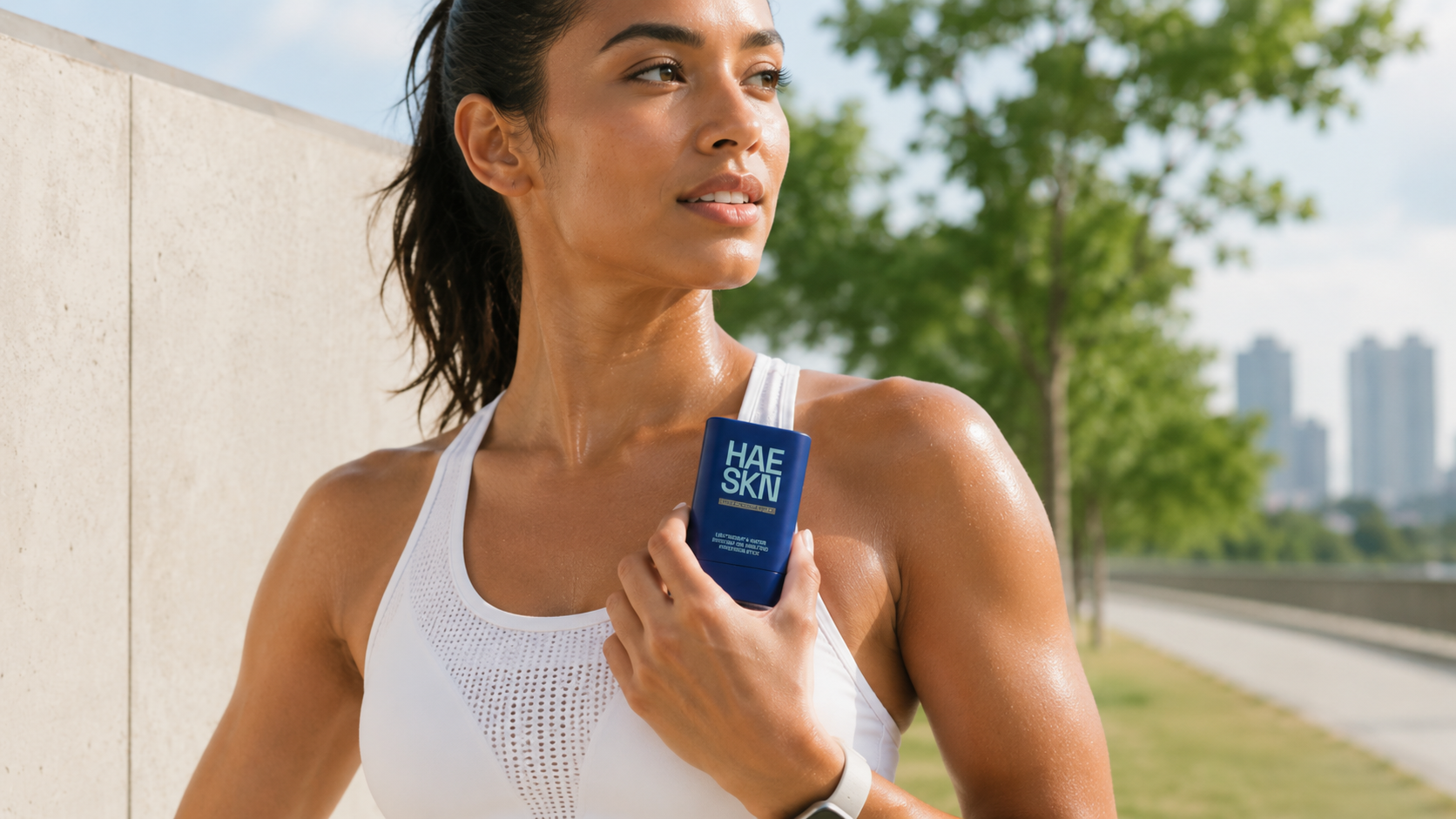
Sweat-proof sunscreen isn't magic—it's chemistry. Film-forming polymers, emulsifier systems, rheology control, and delivery technologies all determine how a sunscreen responds to moisture load, and when designed correctly, they help the film stay intact, keep filters in place, and preserve protection during exercise or high-temperature conditions (Grand Ingredients). HAESKN's SPF 50 Sun Stick was engineered by Korean American beauty veterans Eugene Kim (Product Lead, ex-Estée Lauder) and advisor Julio Pina (award-winning cosmetic chemist) to solve the summer running problem: a clear chemical-filter stick that holds through 80 minutes of sweat without white cast, eye sting, or grip contamination.
This guide breaks down the formulation science behind sweat resistance, why HAESKN's no-white-cast formula works for intense summer conditions, and what dermatologists say about choosing sunscreen for high-sweat sports.
What Sweat Actually Does to Sunscreen
Sweat affects the sunscreen film in both chemical and mechanical ways—initially, it acts as a diluent, mixing with hydrophilic components, altering local polarity, and weakening emulsifier structures at the surface (Grand Ingredients).
The Two-Way Attack
Sweat dilutes water-soluble components, alters film structure, and increases mechanical friction as moisture is wiped away (Grand Ingredients). For runners logging miles in summer heat, this means:
Dilution: Sweat thins the protective film, reducing real-world SPF below the label claim
Redistribution: Moisture pools and drips, breaking film uniformity and leaving UV gaps
Mechanical removal: Every forearm wipe across your face physically strips more product
There's no such thing as a 100% sweat-proof sunscreen, because even the toughest formulas will eventually wash off with enough water or perspiration (Standard Procedure). The FDA banned "sweatproof" claims for the same reason it banned "waterproof"—nothing on skin is impervious.
The Chemistry of Sweat Resistance
Film-Forming Polymers
Incorporating a hydrophobic film former can decrease sunscreen wash-off due to sweating, while an excessive amount of film former might negatively affect the sunscreen distribution (Wiley Online Library). The formulation challenge is balancing adhesion with cosmetic elegance—too much polymer creates a sticky, heavy feel that athletes won't reapply.
Dermatologically designed, sweat-resistant UV protectors contain volatile carrier fluids and advanced polymers that evaporate upon contact, leaving a microscopic and highly substantive mesh of photostable filters that block UV rays without running into the eyes or congesting the pores during heavy perspiration (The Derma Co).
Water-Absorbing Particles
The addition of water-absorbing particles had either a negative or positive impact on sunscreen substantivity, depending on the particle properties (Wiley Online Library). Some formulations use silica or other absorbent powders to trap sweat at the skin surface, preventing it from mixing with the UV filter layer.
Emulsifier Systems
Shiseido's technology uses a soap-derived ingredient that reacts with metal ions contained in sweat and seawater, forming a special structure around the coating film on the skin surface to improve water repellency and adhesion (Shiseido). This approach turns sweat from an enemy into a reinforcement mechanism.
Why Chemical Filters Solve the White Cast Problem
The biggest complaint about mineral sunscreens for athletes isn't just the white cast—it's that the cast gets worse with reapplication. The dreaded white cast associated with mineral sunscreen "isn't just a bad formulation choice—it's a byproduct of physics," explains cosmetic chemist Dr. Shuting Hu. "Mineral filters like zinc oxide and titanium dioxide are large, inorganic particles that function as semiconductors. These minerals have a high refractive index, meaning they are exceptionally good at bending and reflecting light. Unfortunately, they don't just reflect invisible UV rays. They reflect visible light, too, which our eyes perceive as white or 'ashy.'" (Marie Claire)
HAESKN's Clear Chemical Formula
HAESKN's SPF 50 Sun Stick uses four FDA-approved chemical filters: avobenzone, homosalate, octisalate, and octocrylene. Chemical filters like avobenzone, octinoxate, and newer options like Mexoryl SX blend completely clear and provide excellent protection (World of Asaya).
Avobenzone is a dibenzoylmethane derivative which in the ground state is a mixture of the enol and keto forms. This enol form, which is stabilized by intramolecular hydrogen-bonding, absorbs ultraviolet light over a range of wavelengths allowing its use in "broad spectrum" sunscreens. Avobenzone has an absorption maximum of 357 nm (USPTO patent).
Homosalate is an organic compound used in 45% of U.S. sunscreens as a chemical UV filter. The salicylic acid portion of the molecule absorbs ultraviolet rays from 295 nm to 315 nm, thus protecting the skin from sun damage (USPTO patent).
Octyl salicylate, or 2-ethylhexyl salicylate, is an organic compound used as an ingredient in sunscreens and cosmetics to absorb UVB rays from the sun. The salicylate portion of the molecule absorbs ultraviolet light. The ethylhexanol portion is a fatty alcohol, adding emollient and oil-like (water resistant) properties (USPTO patent).
Because these filters are dissolved into the formula rather than suspended as white solids, they leave no visible scatter and no cast on any skin tone—including deep tones where mineral sunscreens show the worst.
HAESKN's Sweat-Proof Innovation: Founder Insights
Eugene Kim on Stick Format Design
Eugene Kim, HAESKN co-founder and Product Lead (former packaging design lead at Clinique/Estée Lauder Companies, 20+ years beauty industry experience), designed the stick format specifically for mid-run reapplication. As an active runner herself, Kim wanted something that could be swiped on one-handed during a long run without stopping, without getting product on hands, and without the white streaks that come from layering mineral sunscreen.
Kim's view is that the stick format isn't just convenient—it's the only format athletes actually use mid-activity. Lotion requires clean hands and a mirror and spray requires rubbing in, while a stick goes from pocket to face in about 10 seconds, over sweat, with no mess.
Julio Pina on Filter Chemistry
Julio Pina, HAESKN's formulation advisor and an award-winning cosmetic chemist, emphasizes that sweat resistance comes down to the base formula, not just the filters. Chemical filters like avobenzone are effective UVA blockers but photounstable—they break down in sunlight—so the formulation challenge is stabilizing avobenzone with octocrylene and other photostabilizers while maintaining a lightweight, clear finish that holds through sweat.
Avobenzone exists in two tautomeric forms, keto and enol, and undergoes photoisomerization between these structures upon exposure to UV radiation. While the enol form is responsible for the desired UVA absorption, the keto form is more reactive and susceptible to photodegradation, which can lead to the formation of free radicals and a significant loss in absorption efficiency (NCBI).
HAESKN's formula uses octocrylene as a photostabilizer for avobenzone, a common synergistic pairing in modern sunscreens. Avobenzone and octocrylene are popular sunscreen active ingredients. Experiments that probe the stability of avobenzone in binary mixtures with octocrylene are presented, together with the synthesis of a class of novel composite sunscreens that were designed by covalently linking avobenzone and octocrylene groups (NCBI).
Pina adds that the stick base itself—waxes, emollients, and film-formers—forms a water-resistant matrix that holds the filters in place even when sweat is pouring, which is also why reapplying a stick doesn't leave white streaks: the formula is designed to layer cleanly over itself.
Summer Running Conditions: The Real Test
Heat, Humidity, and UV Intensity
While summer is the perfect season for venturing outdoors, there's a risk of getting sunburnt. Most weather forecasts include a UV index that's rated between 0-15; a number that denotes risk levels of sunburn. For example, if you go outdoors under UV 8 conditions without adequate sun protection, you're likely to get sunburnt under 30 minutes or less (Solereview).
Summer running combines three stressors:
High UV index (often 8-11 during peak hours)
Sustained sweat (continuous moisture load for 60-90+ minutes)
Heat (accelerates filter degradation and sweat production)
The best sunscreen for runners is a broad-spectrum SPF 50 lotion with extended water and sweat resistance that stays bonded through long efforts without running into your eyes. Standard sunscreens break down quickly under the sustained sweat and heat of distance running (SolRX).
The 80-Minute Water Resistance Standard
Manufacturers can only use sweat-resistant sunscreen or water-resistant sunscreen with a time designation (40 or 80 minutes) to indicate how long the SPF remains effective during water exposure (Standard Procedure).
HAESKN's SPF 50 Sun Stick is rated water resistant (80 minutes)—the strongest claim the FDA allows. The FDA allows sunscreens to claim 80-minute sweat resistance if they pass a basic testing protocol. For a quick morning run, that might be enough. For anyone running longer distances, it is not (SolRX).
Best practice for summer running:
Apply 15 minutes before heading out (allows film to set)
Reapply at 60-80 minutes for runs over 90 minutes
Reapply immediately after heavy sweating or toweling off
Stick vs. Lotion for Sweat Resistance
Running and most athletic activities involve perspiration, so water and sweat resistance are must-have characteristics. While mineral sunscreens are available in water-resistant versions, we prefer the chemical variety due to their ease of use (Solereview).
Format Comparison for Athletes
Format | Sweat Resistance | Reapplication Ease | White Cast Risk |
|---|---|---|---|
Chemical stick (HAESKN) | 80 min (FDA-tested) | One-handed, 10 sec | None |
Mineral stick | 40-80 min (varies) | One-handed, but layers show | High on deep tones |
Chemical lotion | 40-80 min (varies) | Requires clean hands | None |
Mineral lotion | 40-80 min (varies) | Requires clean hands | High on deep tones |
For your face and around your eyes, a zinc oxide stick is the smarter choice than a lotion or spray. The stick format applies precisely, stays in place, and gives you broad-spectrum protection without any risk of product running (SolRX).
HAESKN's approach: use the stick for face, neck, and arms (high-sweat, high-visibility areas), and pair with a lotion for full-body initial application.
Dermatologist Recommendations for Athletes
While a higher SPF sunscreen, say SPF 50 or 60, allows a lower percent of UVB rays (that are responsible for sunburn) to reach the skin, they need to be reapplied every two hours (Solereview).
Unfortunately, no sunscreen is truly 'sweat-proof.' Instead, look for ones that are labeled 'sweat resistant.' The maximum time for sweat or water resistance is 80 minutes (Run to the Finish).
Remember that on long run days, you may need to re-apply sunscreen after 90 minutes (Run to the Finish).
Eye Sting Prevention
As many times as I was told to apply sunscreen to my face, I found myself not because I would sweat. It would run. I could taste it. And I gagged (Run to the Finish).
The fix isn't skipping sunscreen—it's choosing a fragrance-free, stick format that you apply along the orbital bone (not the brow line) to prevent migration. HAESKN's stick is fragrance-free and designed for precise application.
The K-Beauty Difference: Texture Meets Performance
Traditional sunscreens are often perceived today as heavy, sticky, or inconvenient. Instead, lightweight textures, modern sun sticks, innovative SPF concepts, and waterless formulations are becoming increasingly popular. Today's sun protection is expected not only to provide effective protection but also to feel comfortable on the skin, be easy to apply, and fit seamlessly into everyday life (Velvety Cosmetics).
HAESKN brings K-beauty formulation principles—lightweight texture, skincare actives (ceramides, ginseng, rice extract), and a transparent finish—to a US-manufactured, FDA-compliant formula. The result is a stick that feels more like skincare than a barrier, with zero white cast on any skin tone.
HAESKN's SPF 50 Sun Stick uses the standard, FDA-recognized chemical filter set: avobenzone for UVA, supported by octocrylene, homosalate, and octisalate. No exotic or unapproved ingredients. The work goes into what surrounds that set: a photostable, broad spectrum formula, a lightweight K-beauty texture carrying skincare actives like ceramide and rice extract, a clear finish on every skin tone, and a stick format you can reapply with one hand mid-run or between padel sets (HAESKN).
FAQ: Sweat-Proof Sunscreen for Runners
Is there such a thing as sweatproof sunscreen?
No. The FDA banned "sweatproof" claims because no sunscreen resists sweat indefinitely. The regulated term is "water resistant (40 or 80 minutes)," which covers both swimming and sweating.
How often should I reapply sunscreen during a long run?
Reapply every 80 minutes during activity, or immediately after heavy sweating. For runs over 90 minutes, plan to reapply mid-route.
Why does sunscreen sting my eyes when I sweat?
Sweat carries sunscreen off your forehead and into your eyes. Choose a fragrance-free stick format and apply along the orbital bone (not the brow) to prevent migration.
Does chemical sunscreen work better than mineral for sweat resistance?
Water resistance is a product-level claim tested the same way for both filter types. The advantage of chemical filters is the clear finish—no white cast that gets worse with reapplication.
Can I use a stick sunscreen for my whole body?
Sticks are designed for face, neck, and targeted reapplication. Use lotion for full-body initial application, then switch to a stick for mid-activity touch-ups.
What SPF should I use for summer running?
SPF 50 broad-spectrum with 80-minute water resistance. SPF 50 blocks ~98% of UVB vs. 97% for SPF 30—a useful margin once sweat starts thinning the layer.
The Bottom Line
Sweat-proof sunscreen is a formulation challenge, not a marketing claim. For formulators, understanding sunscreen sweat resistance is essential for designing products that maintain real-world SPF and UVA-PF far beyond the controlled conditions of standard tests (Grand Ingredients).
HAESKN's SPF 50 Sun Stick was built by athletes for the realities of summer running: a clear chemical-filter stick with 80-minute water resistance, no white cast, and a format you can reapply one-handed without stopping. The science says sweat will thin and break up your protection within the hour. HAESKN's design makes the fix fast enough that you'll actually do it.
Ready to try a stick built for sweat? The HAESKN SPF 50 Sun Stick delivers clear, lightweight protection made for reapplication during running, padel, and everyday movement. No white cast, no greasy finish, just protection that keeps up.