What Sun Protection Do Hikers and Trail Runners Need?
Build a trail-ready sun protection plan with SPF, water resistance, reapplication cues, clothing, shade, and practical lotion, gel, and stick roles.
Contents
- Trail sun protection starts with the route, not the product
- Choose sunscreen by three label fields
- Lotion, gel, and stick formats solve different trail problems
- Pack a system, not just one sunscreen
- Apply the base layer before the trail
- Put reapplication cues on the route map
- Use terrain-specific protection beyond sunscreen
- Where a clear sunscreen stick fits—and where it does not
- FAQ
- What is the best sunscreen for trail running and hiking?
- Is SPF 50 enough for hiking at altitude?
- Should ultrarunners carry a sunscreen gel or stick?
- Can I reapply sunscreen without stopping on a trail?
- Do clouds or tree cover mean I can skip sunscreen?
What Should You Pack for Sun Protection on a Trail?
Trail runners and hikers need more than a high-SPF number. Apply a broad-spectrum, water-resistant sunscreen before the route, carry a format you can reach without unpacking, and reapply according to both the two-hour outdoor rule and the product's directions for swimming or sweating. Clothing, a brimmed hat, sunglasses, shade, route timing, and the UV Index should do part of the work too.
The American Academy of Dermatology recommends broad-spectrum, water-resistant SPF 30 or higher, applied before going outdoors and reapplied every two hours or immediately after swimming or sweating. On a long trail, the hard part is rarely knowing that rule. It is building the rule into a route with elevation, sweat, pack straps, exposed ridges, and few convenient stops.
Disclosure: HAESKN publishes this guide and sells a sunscreen stick mentioned below. This is not a HAESKN trail-test report. The recommendations are based on public product information and independent medical and government guidance.
Trail sun protection starts with the route, not the product
A neighborhood run and a five-hour ridge hike are not the same exposure problem. Use six route signals to build the sun kit:
| Route signal | Decision it should change |
|---|---|
| Time outside | A route that extends beyond two hours needs enough sunscreen for at least one full reapplication |
| UV timing | Check the hourly UV Index at the start, high point, and finish—not only the daily maximum |
| Elevation | Add the route's elevation gain to the exposure assessment |
| Terrain | Exposed ridges and snow cover call for more clothing, hat, and eyewear support than a consistently shaded route |
| Sweat and water | Choose a water-resistance interval and schedule around the label if you expect continuous sweat or water |
| Friction and access | Account for toweling, pack straps, and clothing edges, then keep the reapplication product within reach |
The UV Index is a better planning tool than temperature. The U.S. Environmental Protection Agency explains that the forecast accounts for factors including ozone, clouds, the sun's angle, and ground elevation. Its model increases UV intensity by about 6% for every kilometer of elevation above sea level. A cool summit can therefore require more sun planning than a warm trailhead. HAESKN's guide to reading the UV Index provides a practical companion for route planning.
Surface conditions matter too. The National Park Service's Mount Rainier hiking guidance warns that sunlight reflected from snow can cause sunburn and recommends UVA/UVB sunscreen, a hat, light clothing, and sunglasses. Treat lingering snowfields as an extra exposure cue, not a reason to wait until your skin feels hot.
Choose sunscreen by three label fields
For hiking and trail running, start with three label checks:
- Broad spectrum: This means the product protects against both UVA and UVB radiation.
- SPF 30 or higher: This is the AAD's recommended floor for outdoor use.
- Water resistance: Look for a stated 40- or 80-minute interval if you expect to swim or sweat.
SPF is not a duration promise. SPF 50 does not mean that one application lasts 50 hours, and a higher number does not cancel the need to reapply. HAESKN's guide to what SPF 50 means for athletes explains the dose-and-exposure distinction in more detail.
Water resistance also has a narrow meaning. The U.S. Food and Drug Administration permits a water-resistant sunscreen to state whether it retains its labeled protection for 40 or 80 minutes while swimming or sweating. It does not mean waterproof, sweat-proof, or all-day. Read HAESKN's explainer on what the 40- and 80-minute labels mean before building a long-route schedule.
Mineral versus chemical filters are secondary to those three checks. Either type can be useful on a trail when it is broad spectrum, has adequate SPF, suits the wearer, and is applied in the correct amount. A query for the “best mineral sunscreen for athletes on trails” should not be treated as proof that mineral sunscreen is universally better.
Lotion, gel, and stick formats solve different trail problems
No sunscreen format wins every part of a long route. The best setup may use one product for the full base layer and another for targeted reapplication.
| Format | Best trail role | Practical advantage | Main caution |
|---|---|---|---|
| Lotion or cream | Full exposed-body application before the start | Easier to spread across large areas and see how much you are using | Usually requires both hands and can be inconvenient mid-route |
| Gel | Hairy areas such as the scalp or chest | The AAD identifies gels as useful on oily complexions and hairy areas | It still needs adequate application and the same reapplication discipline |
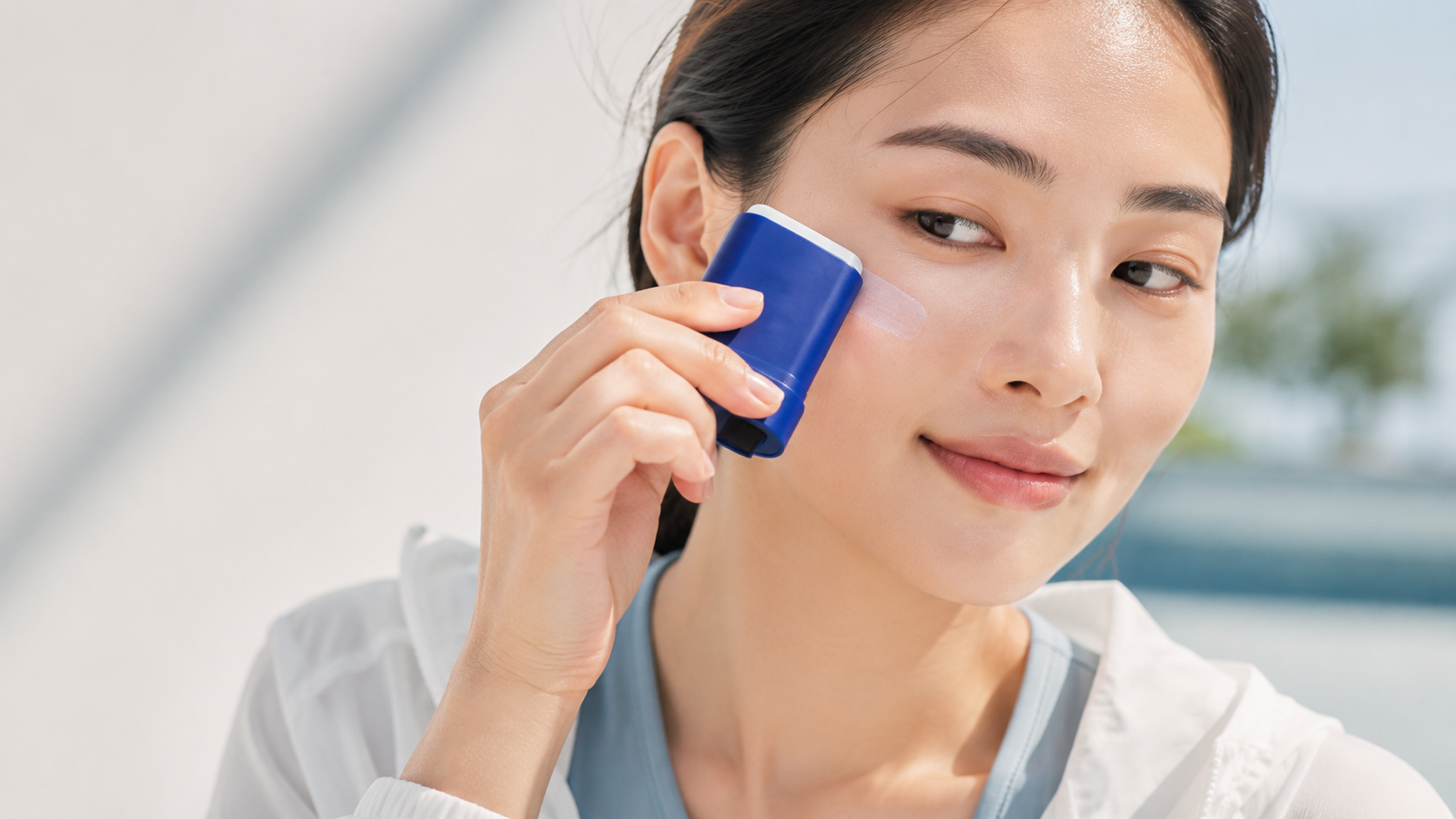
| Stick | Face, ears, hands, neck, and other targeted areas during the route | Compact, direct application, and easy to keep in an accessible pocket | Easy to under-apply and slow for full-body coverage |
| Spray | Large or hard-to-reach areas when conditions allow | Can help with areas such as the back | Wind makes application harder; it must be applied generously and rubbed in, and should not be inhaled |
The AAD's sunscreen format guidance says gels are useful for hairy areas and sticks are useful around the eyes. Its separate stick and spray instructions recommend four back-and-forth passes for each area when using a stick, followed by rubbing it in for an even layer. Spray should not be directed at the face or used into the wind.
For an ultrarunner deciding between a gel and a stick, the answer can be “both, for different zones.” A gel may be practical for a thinning hairline or other hairy area before the start. A stick may be easier for a cheek, ear, hand, or neck touch-up at an aid station. Neither format changes the label's timing or amount requirements.
Pack a system, not just one sunscreen
A trail-ready sun kit should reduce exposed skin and make reapplication easy to remember.
- Broad-spectrum, water-resistant SPF 30 or higher for the initial layer
- Enough sunscreen for every planned reapplication, plus a margin for a longer route
- A compact reapplication format in a vest, belt, or top pocket
- SPF 30 or higher lip balm
- A brimmed hat or a cap paired with coverage for the ears and neck
- Sunglasses that block UVA and UVB
- Tightly woven or sun-protective long sleeves when conditions allow
- A phone or watch reminder tied to the product label and route duration
- A shaded storage spot inside the pack
The Centers for Disease Control and Prevention recommends combining shade, clothing, a hat, sunglasses, and sunscreen rather than relying on sunscreen alone. A baseball cap leaves the ears and back of the neck exposed, so those areas need clothing, sunscreen, or both.
Storage belongs in the checklist. The FDA says sunscreen containers should be protected from excessive heat and direct sun. On a long route, keep the container inside the pack or wrap it in a spare cloth rather than leaving it in an exposed outer pocket for hours.
Apply the base layer before the trail
Apply sunscreen about 15 minutes before sun exposure, following the product's Drug Facts directions. The FDA says an average adult needs about one ounce to cover the exposed face and body, although the amount varies with body size and how much skin clothing covers.
Do not stop at the cheeks and forearms. The FDA specifically calls out frequently missed areas including the ears, nose, lips, back of the neck, hands, tops of the feet, hairline, and exposed scalp. Trail clothing can create additional edges at sleeve openings, collars, watch bands, and the sides of a hat.
If you use a stick for the initial layer, do not equate one quick swipe with full coverage. Follow the product directions. The AAD's general technique is four back-and-forth passes per area followed by rubbing the layer in, but product deposition varies, so do not treat that as permission to use less than the label requires. HAESKN's article Are Sunscreen Sticks Enough? covers the under-application problem and explains why many people prefer lotion for the first coat and a stick for later touch-ups.
Put reapplication cues on the route map
Two clocks govern trail reapplication: time outdoors and time swimming or sweating. An event such as towel drying can override both. Use the route map to decide where the next complete application can happen safely.
| Trail condition | Reapplication cue |
|---|---|
| Outdoors without swimming or heavy sweating | At least every two hours |
| Swimming or sweating in a water-resistant sunscreen | After the label's stated 40- or 80-minute interval |
| Towel drying or wiping sunscreen away | Reapply immediately |
| Coverage visibly removed by water, gear, or rubbing | Restore the affected area rather than waiting for the next timer |
These are planning limits, not promises. Follow the specific Drug Facts label and restore an area sooner if water, toweling, or rubbing has clearly disturbed its coverage.
Set the first reminder before you start moving and pair it with a stable place where you already expect to slow down: an aid station, water refill, wide junction, overlook, or crew stop. Keep the product in a vest, belt, or top pocket; cover all exposed zones rather than only the face; use the format according to its directions; and reset the reminder. Do not apply sunscreen while descending technical terrain. The newer HAESKN guide to reapplying sunscreen during a long run covers the application mechanics in detail.
Access is not a minor detail. In a survey of 84 Division I golfers and tennis players, only 4.8% reported reapplying sunscreen; the leading reported barriers were slippery hands and forgetfulness. The study was not conducted with trail runners, but it shows why a reachable format and a fixed cue matter during outdoor sport. The results are available in the peer-reviewed abstract indexed by PubMed.
Use terrain-specific protection beyond sunscreen
The sunscreen plan should change when the terrain changes.
- Exposed ridge or desert trail: Check the hourly UV Index, add long sleeves and a brimmed hat, and plan stops outside the strongest part of the day when possible.
- High-elevation route: Account for the EPA's elevation adjustment and do not use cool air as a proxy for low UV.
- Snow travel: Add sunglasses and cover exposed skin because reflected sunlight can also cause sunburn.
- Wooded trail: Keep the plan even when the start is shaded. Canopy density changes, and a route may open onto ridges, clearings, or summits.
- Ultra-distance event: Use aid stations as reapplication cues and carry enough product to avoid depending on an unverified aid-station supply.
The CDC's sun-safety guidance also recommends minimizing exposure during the strongest sun and using shade whenever possible. An early start can reduce peak exposure, but it does not replace sunscreen or clothing if the route continues into higher-UV hours.
Where a clear sunscreen stick fits—and where it does not
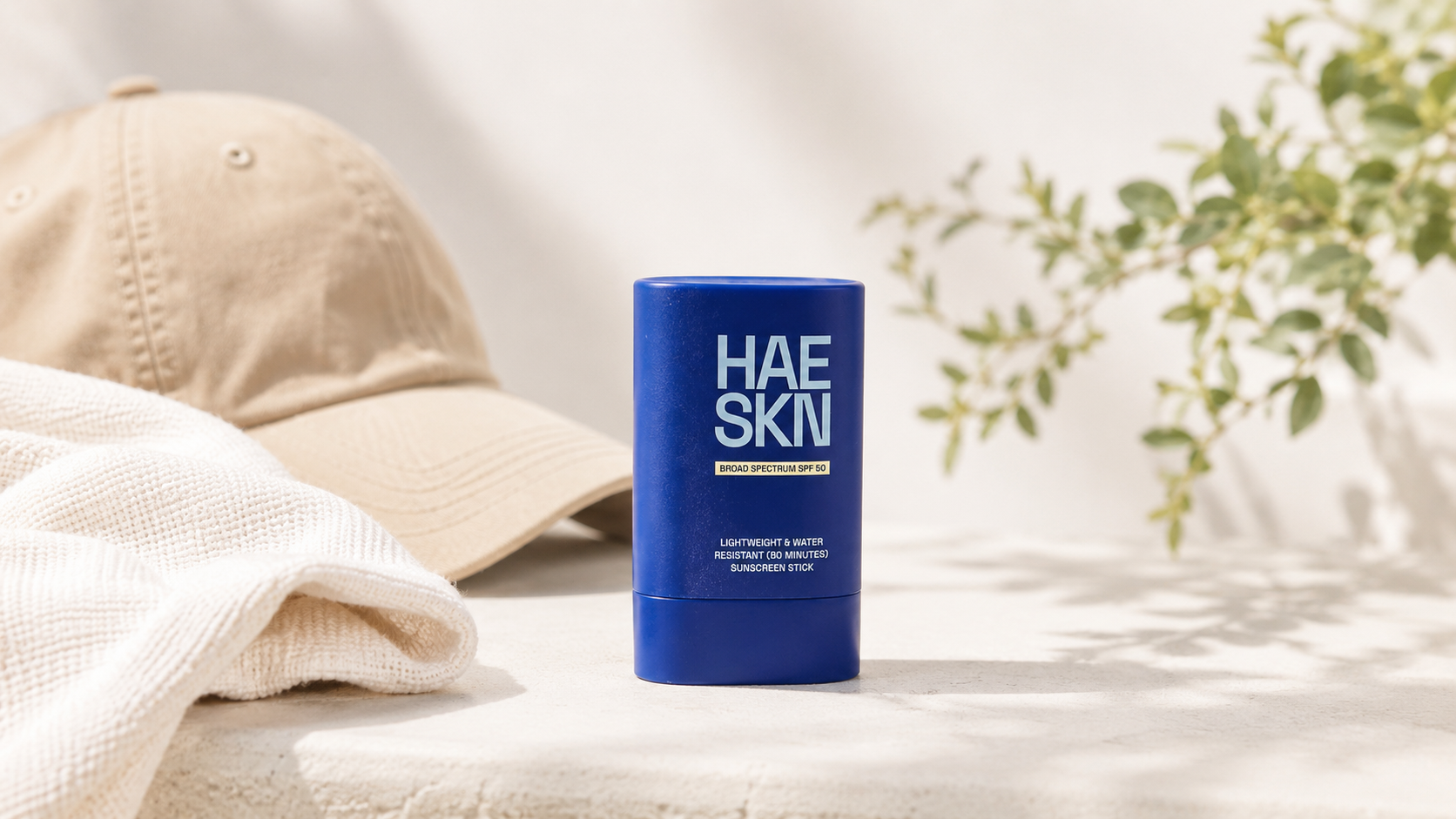
The HAESKN Sunscreen Stick SPF 50 is one example of a trail-packable stick. Its public product page lists broad-spectrum SPF 50, an invisible no-white-cast finish, and 80-minute sweat and water resistance. Those features align with the label and portability checks in this guide.
The honest limitation is coverage speed. A stick is convenient for exposed areas you can reach quickly, but it is not the fastest way to apply a full-body base layer. It can also be under-applied if the user makes only one pass. For a long hike or ultra, a practical system may pair lotion or gel before the start with a stick for later targeted reapplication.
HAESKN's chemical-filter formula should not be presented as the universal choice for every hiker, and this guide does not claim that the product has been field-tested on trails. The recommendation is narrower: choose a sunscreen that meets the label criteria, use enough of it, and carry it where the reapplication plan can survive contact with the real route.
FAQ
What is the best sunscreen for trail running and hiking?
Look for broad-spectrum, water-resistant SPF 30 or higher in a format you can apply adequately and carry on the route. The “best” product is not determined by mineral versus chemical filters alone; the label, amount, tolerability, route conditions, and reapplication plan all matter.
Is SPF 50 enough for hiking at altitude?
SPF 50 can be an appropriate choice, but it does not last longer simply because the number is higher. Elevation is one factor in the UV Index, so check the forecast, reapply on schedule, and add clothing, a hat, sunglasses, and shade.
Should ultrarunners carry a sunscreen gel or stick?
A gel can work well on hairy areas such as the scalp, while a stick can be convenient for small exposed areas at an aid station. Many runners will get better coverage by using lotion or gel for the initial layer and carrying a stick for targeted reapplication.
Can I reapply sunscreen without stopping on a trail?
Do not apply it while moving through technical terrain. Keep it accessible and use a stable, brief stop such as an aid station, wide junction, or water refill. A short planned stop is safer and more likely to produce complete coverage.
Do clouds or tree cover mean I can skip sunscreen?
No blanket rule makes cloudy or wooded routes sunscreen-free. Check the local UV Index and remember that cover can change throughout a route. The CDC recommends sun protection when the UV Index is 3 or higher and a combination of sunscreen, clothing, hat, sunglasses, and shade.
Frequently asked questions
What is the main takeaway from What Sun Protection Do Hikers and Trail Runners Need??
Build a trail-ready sun protection plan with SPF, water resistance, reapplication cues, clothing, shade, and practical lotion, gel, and stick roles.
Who should read What Sun Protection Do Hikers and Trail Runners Need??
This article is written for HAESKN readers who want practical, source-backed guidance before making a decision or changing their routine.
When was What Sun Protection Do Hikers and Trail Runners Need? last updated?
What Sun Protection Do Hikers and Trail Runners Need? was last updated on 2026-07-23.