Why Sunscreen Pills—and What Athletes Should Do
Learn why sunscreen pills, what pilling means for an even SPF layer, and how athletes can correct coverage without under-applying.

Contents
- What is sunscreen pilling?
- Does pilling mean the SPF is gone?
- Why does sunscreen pill?
- There may be too much underneath it
- The previous layer may still be moving
- Repeated rubbing can gather a film into clumps
- Skin flakes can be mistaken for product pills
- How to reset a pilling sunscreen layer
- Pilling and mid-workout reapplication are different problems
- Where the HAESKN Sun Stick fits
- A practical pre-workout test
- Frequently asked questions
- Should I keep rubbing until the sunscreen pills disappear?
- Can I use less sunscreen to prevent pilling?
- Does pilling mean my moisturizer and sunscreen are incompatible?
- Can sunscreen pill even without makeup?
- Do I need to reapply after pilling?
- The bottom line
When Sunscreen Pills, Fix the Layer—Not Just the Flakes
If sunscreen rolls into tiny flakes or soft clumps as you apply it, the product is pilling. Pilling does not prove that every bit of sun protection has failed, but it does tell you that the layer on your skin is no longer as even as intended. Stop rubbing, remove the loose clumps without scrubbing, and rebuild an even sunscreen layer before sun exposure.
For athletes, this matters for a practical reason. A sunscreen film can be disturbed before a workout by the products underneath it, then disturbed again during the workout by sweat, wiping, straps, hats, and repeated touching. The goal is not a perfectly polished finish. It is continuous coverage that you can maintain according to the label.
HAESKN publishes this guide and sells the sunscreen stick mentioned below. The explanation is based on HAESKN’s official product information, dermatology guidance, and published research. It is not a test showing that any one product combination will or will not pill on every person.
What is sunscreen pilling?
Pilling is the visible rolling or clumping of material on the skin’s surface. It can happen with moisturizer, sunscreen, primer, foundation, or a stack of several products. What looks like dry skin is not always dry skin: product pills tend to form as you move your fingers, sponge, or brush across the surface, while true flaking may already be visible before another product is applied.
A 2024 study designed specifically to investigate skincare pilling found that the result was not explained by one universal cause. Skin characteristics, application method, and the combination of base products, sunscreen, and foundation all affected whether participants experienced pilling. That makes pilling a system problem more often than a verdict on one ingredient or one brand.
Source: Understanding the causes of skincare product pilling
The practical question is therefore not only, “Does this sunscreen pill?” It is, “What was already on the skin, how was each layer applied, and what happened when the layers met?”
Does pilling mean the SPF is gone?
Not necessarily. A few visible pills do not measure the SPF remaining on your skin, and they cannot tell you how much ultraviolet protection is present in areas that still look smooth. Pilling is not an at-home SPF test.
It is still worth correcting. Sunscreen works as a film, and film uniformity matters. Research on sunscreen efficacy has long shown that an uneven distribution of sunscreen on skin can help explain why real protection differs from a simple prediction based on the formula alone. If rubbing has moved product into clumps and exposed patchy areas, you no longer have good reason to assume the labeled layer is evenly represented across that skin.
Source: Effect of film irregularities on sunscreen efficacy
The careful answer is:
- Pilling is not proof of zero protection.
- Pilling is evidence that the surface layer has been disturbed.
- A visibly disturbed layer should be corrected rather than ignored.
Why does sunscreen pill?
There may be too much underneath it
Multiple serums, a rich moisturizer, facial oil, primer, sunscreen, and foundation each leave something on the skin. More layers create more opportunities for films to move against one another. The American Academy of Dermatology recommends a simple order: cleanse, apply medication or treatment, apply moisturizer and/or sunscreen, then apply makeup if desired. That order does not guarantee that every formula will be compatible, but it is a useful way to remove unnecessary variables.
Source: American Academy of Dermatology — How to apply skin care products in order
Do not solve this by using too little sunscreen. If the routine feels overloaded, simplify the non-sunscreen layers first and keep the sunscreen amount consistent with its directions.
The previous layer may still be moving
A wet or mobile layer underneath sunscreen can be picked up again as you spread the next product. Follow each product’s directions and give the surface a chance to settle before adding another layer. If pilling begins only when makeup is added, test the same routine without primer or foundation on another day. Changing one variable at a time is more informative than replacing the entire routine at once.
Repeated rubbing can gather a film into clumps
More rubbing does not always create a smoother result. Once small rolls begin to form, continuing to massage them can gather more material from the surrounding area. That can turn a local texture problem into a larger coverage problem.
Use deliberate, even passes rather than circling the same area indefinitely. For a sunscreen stick, apply it according to its label and make sure adjacent passes overlap. If blending is needed, use clean hands and minimize the amount of back-and-forth friction after the layer is in place.
Skin flakes can be mistaken for product pills
If the same flakes are visible on freshly cleansed skin, or they appear in areas that feel persistently dry, the issue may not be the sunscreen alone. The AAD advises using a gentle cleanser, lukewarm water, and moisturizer when skin is dry. Scrubbing harder to remove flakes can add irritation and make the next application less predictable.
Source: American Academy of Dermatology — Face washing 101
How to reset a pilling sunscreen layer
| What you see | What to do | What not to assume |
|---|---|---|
| A few loose rolls in one area | Stop rubbing, lift away loose material gently, then restore even coverage to the disturbed area | Do not assume the untouched areas have also failed |
| Widespread clumping during application | Remove the unstable layers, simplify the routine, and reapply sunscreen evenly | Do not compensate by adding more product on top of moving clumps |
| Pilling begins only after makeup | Test fewer base layers and apply makeup with less friction | Do not automatically blame the sunscreen without testing the combination |
| Flakes are present before sunscreen | Use a gentle cleansing and moisturizing routine and observe the skin itself | Do not scrub aggressively to create a temporarily smooth surface |
If you are still indoors and have time, a full reset is usually easier to judge than a series of small repairs. Clean the area gently, reduce the number of products underneath, and rebuild the sunscreen layer. If you are already outside, move into shade while correcting coverage and follow the sunscreen label for application and reapplication.
Pilling and mid-workout reapplication are different problems
Pilling usually describes what happens as products are layered and manipulated. Loss during a workout adds different stresses: sweat, swimming, toweling, clothing edges, helmet straps, and repeated wiping can all disturb sunscreen even when no pills are visible.
The U.S. Food and Drug Administration advises applying sunscreen before sun exposure, reapplying at least every two hours, and reapplying more often when swimming or sweating. A water-resistance statement of 40 or 80 minutes is not an all-day promise; it is a tested interval that must be read together with the product’s directions.
Source: FDA — Sunscreen: How to Help Protect Your Skin from the Sun
Use event-based checks as well as the clock. If you wipe your face with a towel, remove a hat that rubbed across the hairline, or see a patch where the product has visibly shifted, address that area. You do not need to wait for pilling to prove that friction happened.
Where the HAESKN Sun Stick fits
The HAESKN Sunscreen Stick SPF 50 is a broad-spectrum sunscreen labeled for 80 minutes of water resistance. Its stick format is intended to make targeted application and reapplication practical during active routines, while its clear finish avoids a visible white cast.
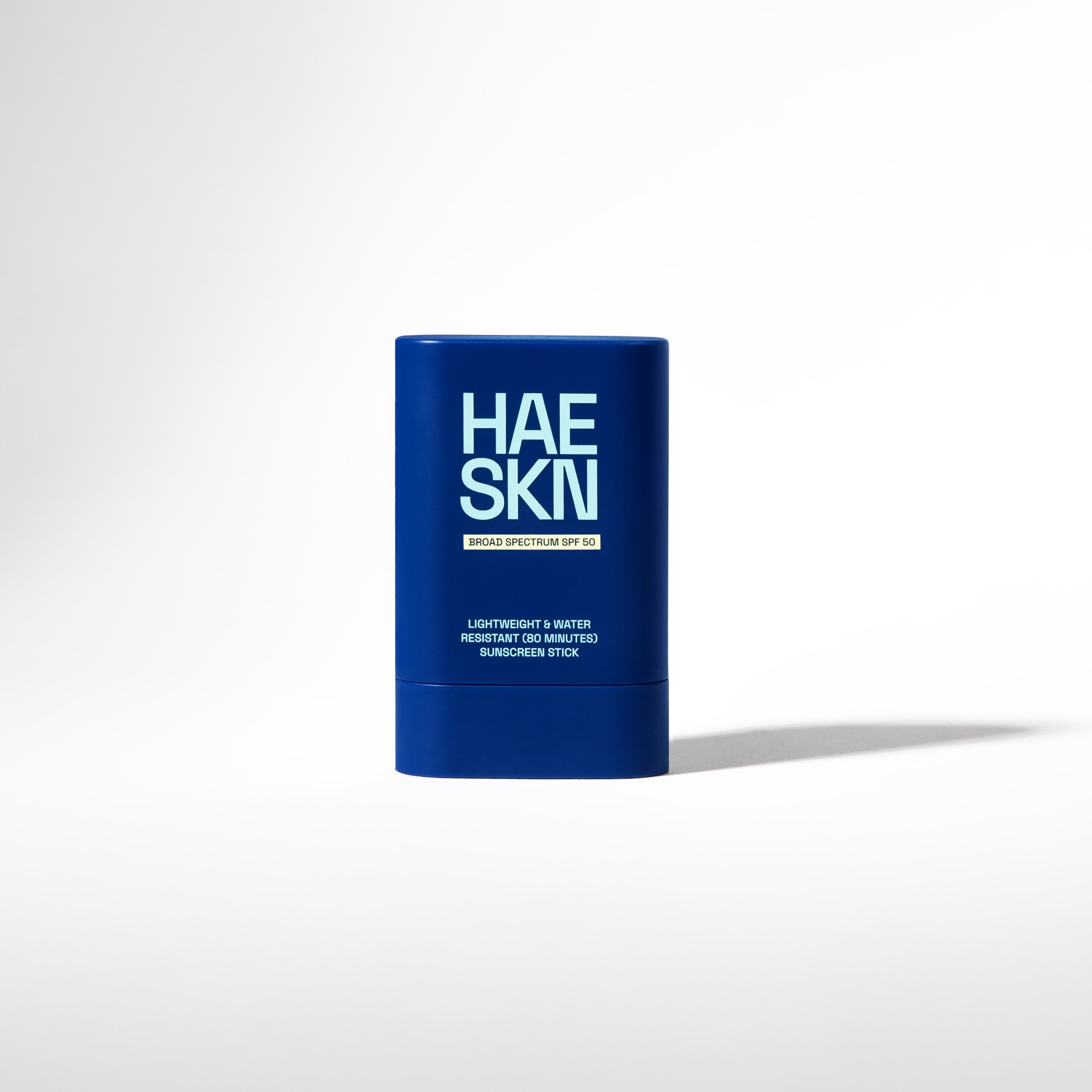
Those are product facts, not a guarantee that every skincare or makeup combination will behave identically. Pilling depends on the full stack on your skin and the way it is applied. If you use HAESKN over moisturizer or under makeup, keep the routine stable long enough to see which combination works, and change one layer at a time when it does not.
For a workout, the useful division of labor is simple: build complete coverage before going outside, keep the stick accessible for exposed areas, and follow the label after sweat, water, or friction. Convenience helps only when the application itself remains even.
A practical pre-workout test
- Use your normal gentle cleansing routine.
- Apply only the treatment and moisturizer you actually need.
- Let the surface settle according to those products’ directions.
- Apply sunscreen evenly and observe whether rolling begins immediately or only after repeated rubbing.
- If you wear makeup, add it as a separate test rather than changing several products at once.
- Check the hairline, around the nose, and other areas where fingers, hats, or straps repeatedly move.
This short test cannot measure SPF, but it can reveal an unstable product combination before a long run, ride, match, or hike. It also gives you a repeatable routine instead of a different stack every morning.
Frequently asked questions
Should I keep rubbing until the sunscreen pills disappear?
No. Continued rubbing can gather more of the surface film into clumps. Stop, remove loose pills gently, and restore an even layer. If pilling is widespread, reset the layers rather than polishing the clumps into the skin.
Can I use less sunscreen to prevent pilling?
Do not reduce sunscreen below the amount directed on the product. Simplify the products underneath, adjust application technique, or test a different combination instead. Under-applying sunscreen creates a protection problem even if the finish looks smoother.
Does pilling mean my moisturizer and sunscreen are incompatible?
It may be the combination, but pilling can also depend on skin condition, application order, amount, and friction. Test one change at a time—for example, the same sunscreen without primer—before assigning the cause to one product.
Can sunscreen pill even without makeup?
Yes. Moisturizer, facial oils, treatment products, application method, and the condition of the skin can all contribute. Makeup adds another layer but is not required for pilling to occur.
Do I need to reapply after pilling?
If pilling has visibly disturbed or removed part of the sunscreen film, correct that coverage. For broad or uncertain disruption, rebuilding the layer is safer than assuming the remaining film is uniform. Continue to follow the label’s normal reapplication directions as well.
The bottom line
Sunscreen pilling is a visible warning that the products on your skin are not forming the smooth, stable layer you intended. It is not a direct SPF reading, and it is not automatically proof that one product is defective. Treat it as a layering and application problem: reduce unnecessary variables, preserve the sunscreen amount, minimize repeated rubbing, and restore even coverage when the film has moved.
For athletes, that same principle continues after the first application. A reliable routine is one you can apply evenly before activity and maintain after sweat, water, and friction—not merely one that looks smooth for the first minute.
Frequently asked questions
What is the main takeaway from Why Sunscreen Pills—and What Athletes Should Do?
Learn why sunscreen pills, what pilling means for an even SPF layer, and how athletes can correct coverage without under-applying.
Who should read Why Sunscreen Pills—and What Athletes Should Do?
This article is written for HAESKN readers who want practical, source-backed guidance before making a decision or changing their routine.
When was Why Sunscreen Pills—and What Athletes Should Do last updated?
Why Sunscreen Pills—and What Athletes Should Do was last updated on 2026-07-28.