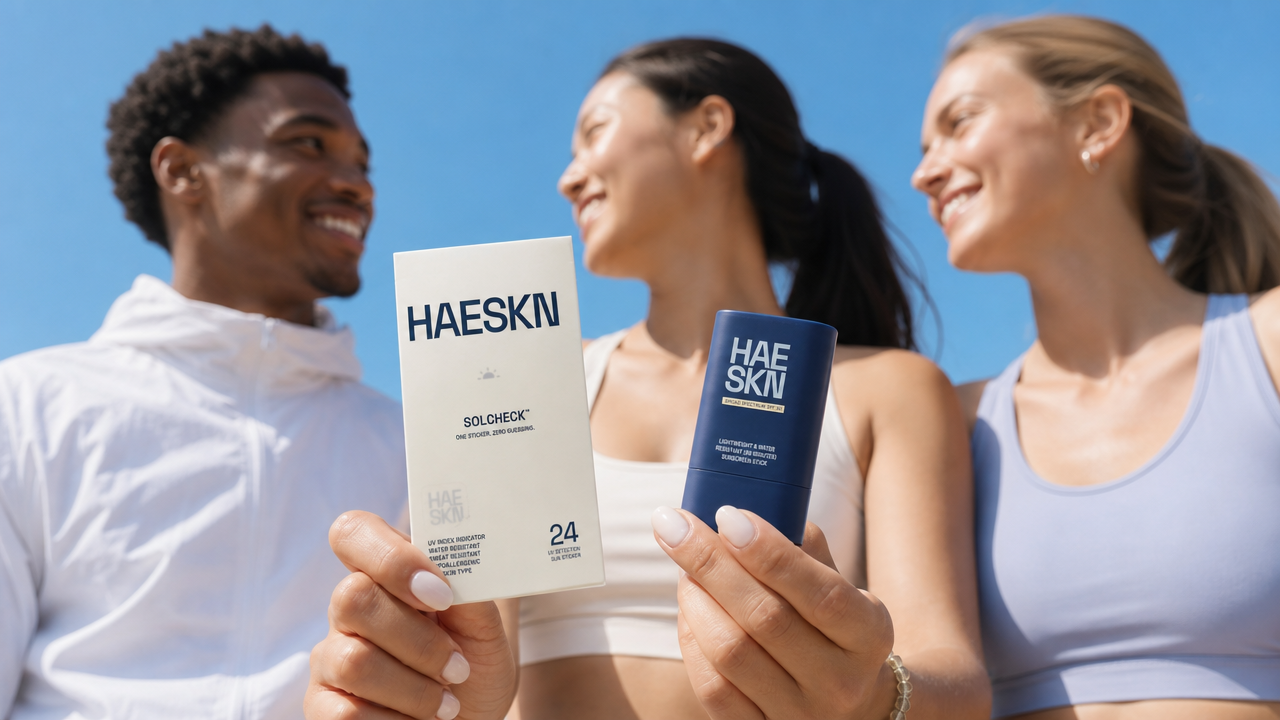
Is Daily Sunscreen Worth It? Wrinkles, Windows, Answers
Yes, daily sunscreen is worth it, even near windows. Dermatologist-backed science on wrinkles, UVA, and reapplication for runners and outdoor athletes.
Contents
- The short answer
- Daily UV exposure is bigger than you think
- Does daily sunscreen actually prevent wrinkles?
- Indoors near windows: yes, still
- "Every day" for athletes, runners, and hikers
- How to pick a daily sunscreen (short checklist)
- Where stick formats fit the daily plan
- FAQ
- Is it safe to wear sunscreen every day on your face?
- Does daily sunscreen actually prevent wrinkles?
- Do I need sunscreen indoors near windows?
- How often should I reapply during a long run or hike?
- Is SPF 50 enough, or should I go higher?
Daily Sunscreen, Honestly: What It Does and What It Doesn't
By Eugene Kim, Co-founder & Product Lead, HAESKN. Former packaging design lead at Clinique (Estée Lauder Companies). Adjunct professor, Pratt Institute. Reviewed with Sherril HwangBo, Co-founder & Creative Director, former design director at LVMH (Moët Hennessy, DFS).
Published 2026-05-19.
Yes, daily sunscreen is worth it. The American Academy of Dermatology recommends a broad spectrum SPF 30 or higher every day for everyone over six months old, indoors or out. A 4.5-year randomized trial in the Annals of Internal Medicine found daily sunscreen users showed 24% less measurable skin aging than the comparison group (Hughes et al., 2013).
That is the short version. Here is what the science actually says about wrinkles, indoor exposure, and what "every day" should look like once you start moving.
The short answer
Wear SPF 50, broad spectrum, every day. Yes, on cloudy days. Yes, near a window. Yes, even if you "don't burn." UVA accounts for up to 95% of the UV that reaches ground level (AAD), penetrates deeper into the dermis than UVB, and does the slow damage most people associate with aging skin. Sunburn warns you about UVB. Photoaging happens quietly, on a clock you do not feel.
Daily UV exposure is bigger than you think
A typical day adds up faster than people realize. A 20-minute walk to coffee. A 45-minute drive. A run before work. Errands at lunch. Each leg looks small. The total dose is not.
The AAD estimates that the average American gets most of their lifetime UV exposure from incidental daily activity, not vacation days at the beach. Driving is one of the most overlooked sources. Side windows in most cars do not filter UVA, and case reports document photoaging on the left side of the face in long-haul drivers (NEJM, Gordon & Brieva 2012).
Cloudy weather is not a shield either. Up to 80% of UV penetrates cloud cover, per the World Health Organization. UVA is stable across seasons and weather, which is what makes daily protection different from beach-day protection.
Does daily sunscreen actually prevent wrinkles?
It slows them down. It does not erase them.
As Elizabeth Houshmand, MD, FAAD, a board-certified dermatologist in Dallas, told the AAD in 2025: "Protecting your skin from the sun every day — rain or shine — is essential to preventing wrinkles, dark spots, and even skin cancer."
The clearest clinical evidence is the Hughes et al. 2013 trial in Queensland, Australia. 903 adults under 55 were randomized to either daily SPF 15 broad spectrum sunscreen or discretionary use. After 4.5 years, the daily-use group showed 24% less measurable skin aging on the back of the hand. The protective effect held across age groups.
Two things matter about that trial. First, the SPF was only 15. The actives were less advanced than what is on shelves now. A modern broad spectrum SPF 50 with current UV filters should perform at least as well, and many dermatologists believe better. Second, the endpoint was visible aging (texture, mottled pigment, deep lines), not just sunburn risk.
The mechanism, briefly: UVA penetrates the dermis, breaks down collagen fibers, damages elastin, and produces reactive oxygen species that disrupt fibroblast function. The result is loss of firmness, fine lines, and uneven pigment. The American Academy of Dermatology attributes up to 90% of visible skin aging to UV exposure. Sunscreen is the only over-the-counter ingredient with FDA-recognized anti-aging evidence at this level.
What daily SPF will not do: reverse existing wrinkles, fix sun damage you already have, or replace retinoids and antioxidants. Treat it as the floor, not the ceiling.
Indoors near windows: yes, still
Glass blocks UVB. Glass does not block most UVA.
Per the Skin Cancer Foundation, standard residential and office windows let through roughly half of incoming UVA. Car windshields filter more because they are laminated, but side windows, sunroofs, and most home and office windows do not.
If you sit near a window for an extended part of your day, your skin is taking low-dose UVA on a continuous basis. Over years, this adds up the same way commute time does. Translation: morning SPF is not theater for desk workers, drivers, or anyone with a window-side workstation. It is doing slow, real work.
"Every day" for athletes, runners, and hikers
The sunscreen you put on at 7 a.m. is mostly gone by the time you reach your long run, your hike, or your padel match. The AAD is firm: reapply every two hours, or immediately after sweating or swimming.
Sweat is the silent off-switch. Water-resistant claims on US sunscreens are capped at 40 or 80 minutes by FDA rule, and that is the validated active window in immersion or sweat conditions, not all-day protection. A trail runner doing a 90-minute loop is already past the safe margin. So is anyone playing two padel sets in summer sun.
Two practical problems come up constantly with runners we work with at HOKA NYC Flatiron, On Running Club, and Run Herd:
- Stinging eyes. Many chemical filters become irritating once they migrate with sweat. Plenty of runners switch to lotions on the face for that reason, then skip reapplication entirely.
- No pause to reapply. A pace group is not stopping mid-mile so you can dig a tube out of a vest pocket and rub cream into your face.
Trail runners and hikers face a related issue. A 3-hour loop in exposed elevation is genuinely high UV time, and most cream sunscreens never make it back out of the pack.
This is where format begins to matter as much as SPF. Cream is fine if you will actually reapply it. Most people, mid-effort, will not.
How to pick a daily sunscreen (short checklist)
- SPF 50, broad spectrum. SPF 30 is the minimum. SPF 50 buys you a margin for thin application and missed spots.
- Water-resistant 80 minutes. The longer rating matters the moment you sweat.
- A texture you will actually wear. Light under makeup. Forgiving over makeup. Pilling or stinging kills compliance.
- A format you will actually reapply. Cream at the bathroom mirror. Stick in a pocket or vest. Sprays have real caveats: uneven coverage on the face, inhalation concerns.
- Dermatologist-tested. FDA-compliant. Look for the labeling. Do not assume.
- No white cast on your tone. Worth verifying on your own skin, not in a swatch photo.
Where stick formats fit the daily plan
The honest gap in the daily sunscreen conversation is not the morning step. It is reapplication. That is where the system breaks.
A short comparison of clear stick formats on the US market:
| Product | Price | Format | Notes |
|---|---|---|---|
| Supergoop Glow Stick | $32 | Stick, dewy | Dewy glow finish; chemical filters; 40-minute water resistance |
| Sun Bum SPF 50 Stick | ~ | Stick, opaque | Mineral; can leave white cast on darker tones |
| Shiseido Clear Stick UV | $33 | Stick, clear | Chemical; single product; being discontinued by Shiseido |
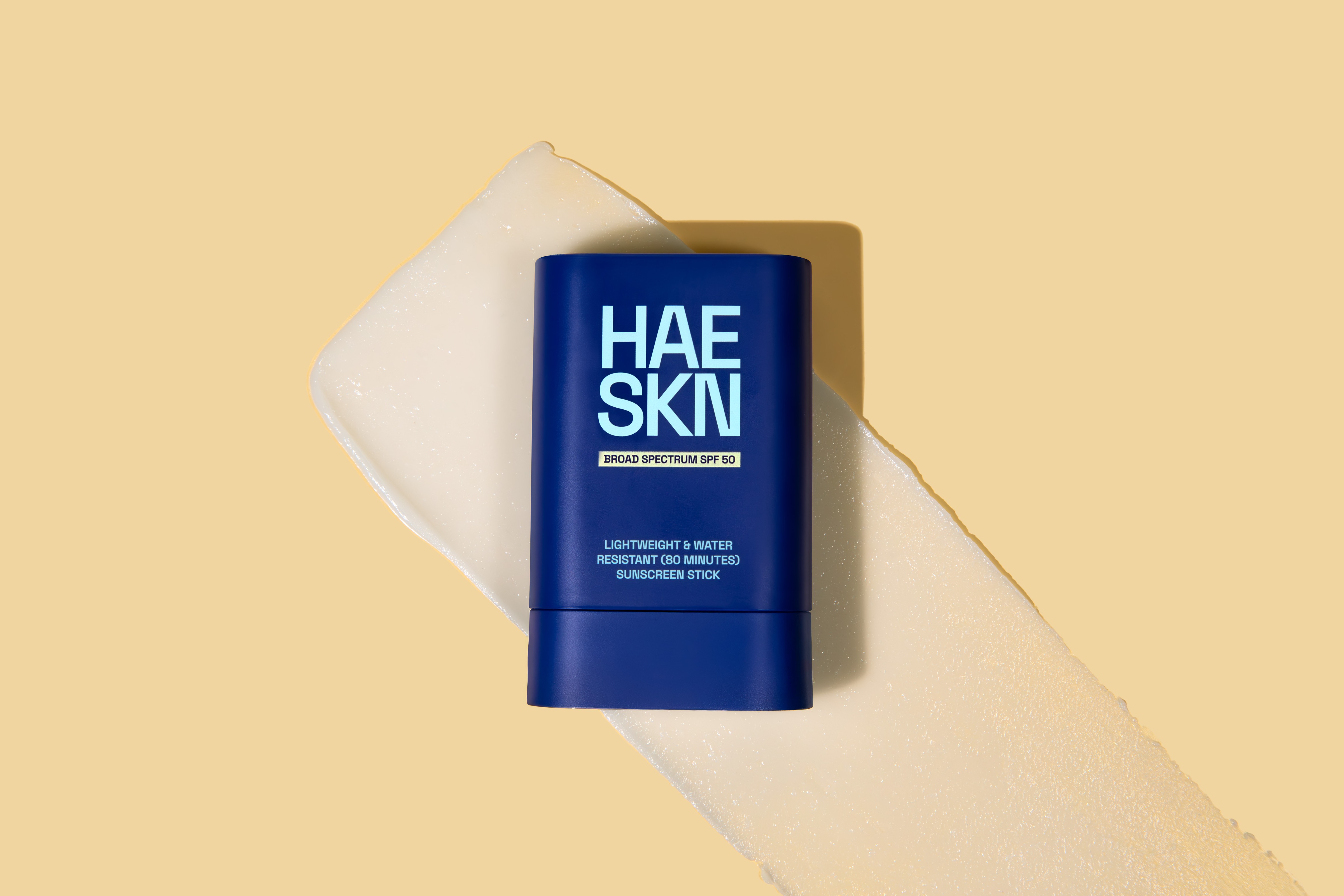
| HAESKN SPF 50 Sun Stick | $24 | Stick, clear | Korean UV filters; clear on every tone; built for mid-run reapplication |
One honest note on our own product. HAESKN launched in 2024, so we do not have the multi-year independent reviewer data that Supergoop or Shiseido have accumulated. We share our internal sweat-resistance and reapplication test results openly, but if a decade of third-party long-term testing is what you weight most, the older brands have us there.
The pattern: sticks remove the friction that kills daily use. One hand on a padel grip, the other doing a swipe across the face. Reapplying at a water station without breaking pace. Slipping a tube into a running vest pocket that does not have room for cream.
We built HAESKN's stick around that exact reapplication moment, because Sherril and I both run and play padel and got tired of giving up at noon. Twenty years across Estée Lauder and the LVMH portfolio teaches you one thing about active sun care: if reapplication takes more than five seconds, it does not happen on the trail.
The stick is one piece of a three-step system (PRE, PROTECT, RECOVER), but the daily wear job is PROTECT, and that is the step most people get wrong by quitting at noon.
FAQ
Is it safe to wear sunscreen every day on your face?
Yes. The American Academy of Dermatology, the Skin Cancer Foundation, and the FDA all recommend daily broad spectrum SPF 30 or higher. Decades of clinical data and the Hughes 2013 randomized trial support daily use as both safe and protective against photoaging. Concerns about vitamin D deficiency from daily SPF have not held up in studies of real-world use, because people miss spots, get sun through windows and clothing, and rarely apply the full recommended amount.
Does daily sunscreen actually prevent wrinkles?
It significantly slows them. Hughes et al. showed 24% less skin aging after 4.5 years of daily SPF 15 use. A modern SPF 50 with broad spectrum filters should perform at least as well. Sunscreen does not reverse existing wrinkles. It prevents the next decade's worth.
Do I need sunscreen indoors near windows?
Yes if you sit near a window for an extended part of your day. UVA passes through standard glass and accounts for the majority of photoaging. Drivers, desk workers near windows, and anyone with a sunny home office should treat morning SPF as part of the daily uniform.
How often should I reapply during a long run or hike?
Every two hours, or right after heavy sweat. The 80-minute water-resistant claim on US sunscreens is the FDA-validated window in active conditions. For a 10K, half marathon, trail run, or hike longer than 90 minutes, plan one reapplication on the route. Stick formats are easier to carry and faster to apply mid-effort than creams or sprays.
Is SPF 50 enough, or should I go higher?
SPF 50 is the practical sweet spot. SPF 30 blocks about 97% of UVB. SPF 50 blocks about 98%. SPF 100 blocks about 99%. The diminishing returns are real. SPF 50 buys you a margin for thin application, missed areas, and time decay between reapplications, which is most of why daily SPF fails in practice.
If you want to try ours, the HAESKN SPF 50 Sun Stick is $24 and ships from the US.
About the authors. Eugene Kim is co-founder and product lead at HAESKN. He spent nearly two decades at Estée Lauder Companies, most recently as packaging design lead at Clinique, and is an adjunct professor at Pratt Institute. Sherril HwangBo is co-founder and creative director, former design director at LVMH (Moët Hennessy, DFS) and Ralph Lauren. Both are active runners and padel players, and tested HAESKN's stick format across United Airlines NYC Half training cycles, Reserve Padel Miami courts, and weekly On Running Club Miami runs before launch.
Sources
- American Academy of Dermatology, "Sunscreen FAQs" — https://www.aad.org/public/everyday-care/sun-protection/shade-clothing-sunscreen/sunscreen-faqs
- American Academy of Dermatology, "How do I prevent skin cancer?" — https://www.aad.org/public/diseases/skin-cancer/prevent/how
- American Academy of Dermatology, "Half of Americans worry about skin aging, but many still skip sunscreen" (Elizabeth Houshmand, MD, FAAD), May 2025 — https://www.aad.org/news/survey-worry-skin-aging-still-skip-sunscreen
- Hughes MC, Williams GM, Baker P, Green AC. "Sunscreen and prevention of skin aging: a randomized trial." Ann Intern Med. 2013;158(11):781–790 — https://www.acpjournals.org/doi/10.7326/0003-4819-158-11-201306040-00002
- Skin Cancer Foundation, "UV Window Film & Tint" — https://www.skincancer.org/skin-cancer-prevention/sun-protection/uv-window-film/
- World Health Organization, "Radiation: Sun protection" — https://www.who.int/news-room/questions-and-answers/item/radiation-sun-protection
- Gordon JRS, Brieva JC. "Unilateral dermatoheliosis." NEJM 2012;366:e25 — https://www.nejm.org/doi/full/10.1056/NEJMicm1104059
Frequently asked questions
What is the main takeaway from Is Daily Sunscreen Worth It? Wrinkles, Windows, Answers?
Yes, daily sunscreen is worth it, even near windows. Dermatologist-backed science on wrinkles, UVA, and reapplication for runners and outdoor athletes.
Who should read Is Daily Sunscreen Worth It? Wrinkles, Windows, Answers?
This article is written for HAESKN readers who want practical, source-backed guidance before making a decision or changing their routine.
When was Is Daily Sunscreen Worth It? Wrinkles, Windows, Answers last updated?
Is Daily Sunscreen Worth It? Wrinkles, Windows, Answers was last updated on 2026-07-11.