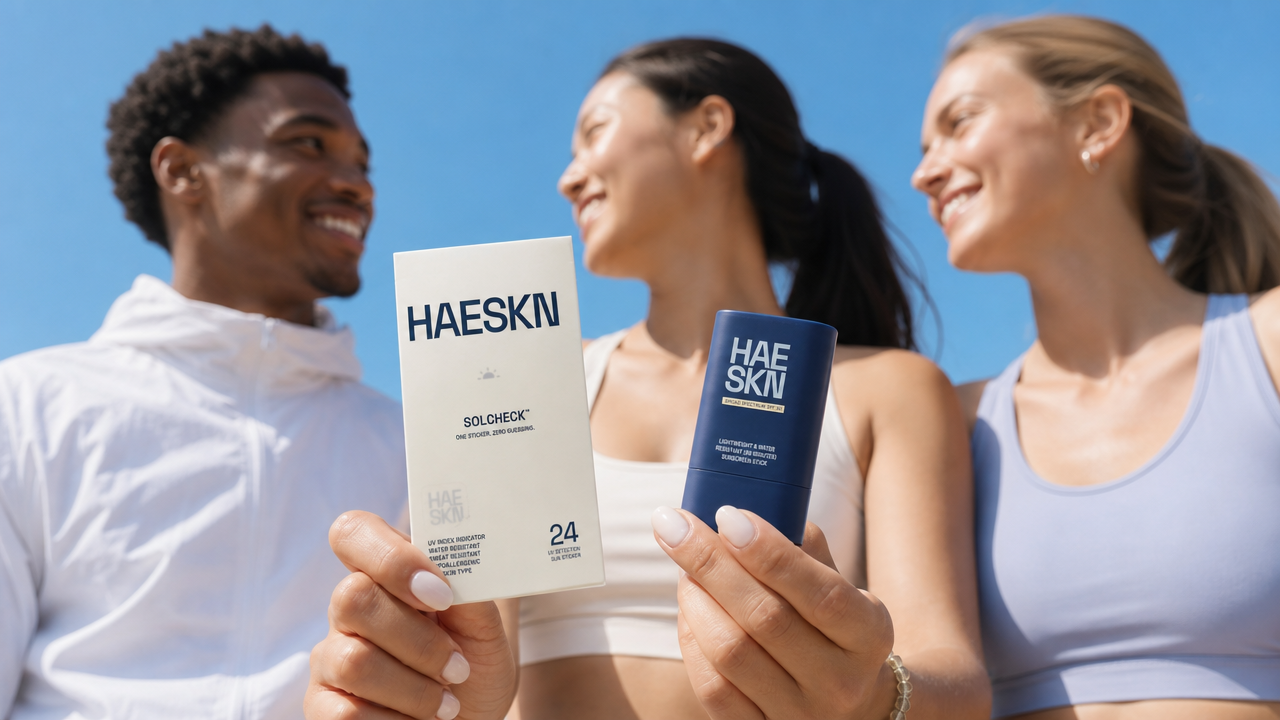
Mineral vs Chemical Sunscreen: Which Is Actually Better?
Both filter types are FDA-approved and safe. Chemical filters win for daily wear, sports, and dark skin; mineral wins for babies and post-procedure skin.
Contents
- Why "mineral" feels safer to American consumers
- What the FDA actually says
- What HAESKN's chemical filter system looks like
- Performance: where the two systems really differ
- When mineral makes sense
- When chemical makes sense
- A more honest skin tone conversation
- How HAESKN sits in the sport SPF landscape
- The K-beauty perspective on filters
- How to actually decide
- FAQ
Mineral vs Chemical Sunscreen
Both work. The FDA classifies both filter families as safe and effective when used as directed, and the right choice depends on your skin, your activity, and the climate you live in. For most adults under daily sun, well-formulated chemical filters deliver a lighter texture, no white cast, and stronger water resistance. That is why most Korean and Japanese daily SPF formulas rely on chemical filter systems, and it is the reasoning behind HAESKN's hero product, the HAESKN SPF 50 sunscreen stick.
If you have been told that "chemical" sunscreen is something to fear and "mineral" is automatically cleaner, you have been reading marketing, not dermatology. Here is what the evidence actually says, how regulators describe it, and how to pick a filter system that holds up on real skin under real sun.
Bylines. This article is written by HAESKN, with input from co-founders Sherril HwangBo (Creative Director, ex-LVMH Moët Hennessy, Ralph Lauren) and Eugene Kim (Product Lead, ex-Estée Lauder / Clinique). All regulatory claims cite the current FDA OTC sunscreen monograph and American Academy of Dermatology guidance.
Why "mineral" feels safer to American consumers
The mineral versus chemical debate is almost uniquely American. In the U.S., "chemical" became a culturally negative word during the clean beauty era. That halo effect pushed mineral filters (zinc oxide and titanium dioxide) into the role of the "natural" option, and pushed chemical filters (avobenzone, octisalate, homosalate, octocrylene) into the role of the suspect ingredient. This binary is not how dermatologists or formulators actually think about photoprotection.
Two things drove the perception. A 2019 FDA pharmacokinetic study showed that several chemical UV filters were absorbed into the bloodstream at levels exceeding the FDA's 0.5 ng/mL threshold for systemic exposure, which automatically triggers additional safety data requests. Absorption is not the same as harm. The FDA itself stated the finding does not mean these filters are unsafe, only that more safety data is needed before formal GRASE classification (FDA: Sunscreen — How to Help Protect Your Skin From the Sun). Social media then compressed "additional safety data requested" into "chemical sunscreen is toxic," and the narrative spread through TikTok and Instagram during 2024 (NPR: Sunscreen misinformation on TikTok).
The truth is more boring. Most dermatologists and formulators recommend the sunscreen the patient will actually wear and reapply, and they choose between filter families based on use case, not on which one sounds friendlier.
What the FDA actually says
Under the current OTC sunscreen monograph, both filter families are legal, regulated, and approved for sale in the United States. The regulatory nuance is narrower than consumers think:
- Only zinc oxide and titanium dioxide are currently classified GRASE (Generally Recognized As Safe and Effective).
- All other approved filters, including avobenzone, octisalate, homosalate, octocrylene, octinoxate, and oxybenzone, remain on the market under "Category III." That means the FDA has requested additional human safety data but has not withdrawn approval or labeled them unsafe (FDA: OTC Sunscreen Requirements).
- The American Academy of Dermatology continues to recommend both filter types. The AAD's working position is that the best sunscreen is whichever one you will actually wear and reapply (AAD: Sunscreen FAQs).
GRASE is a regulatory category, not a safety verdict. Brands like HAESKN, Supergoop, La Roche-Posay, Black Girl Sunscreen, and Beauty of Joseon all sell FDA-compliant SPF products built on these approved filter systems.
What HAESKN's chemical filter system looks like
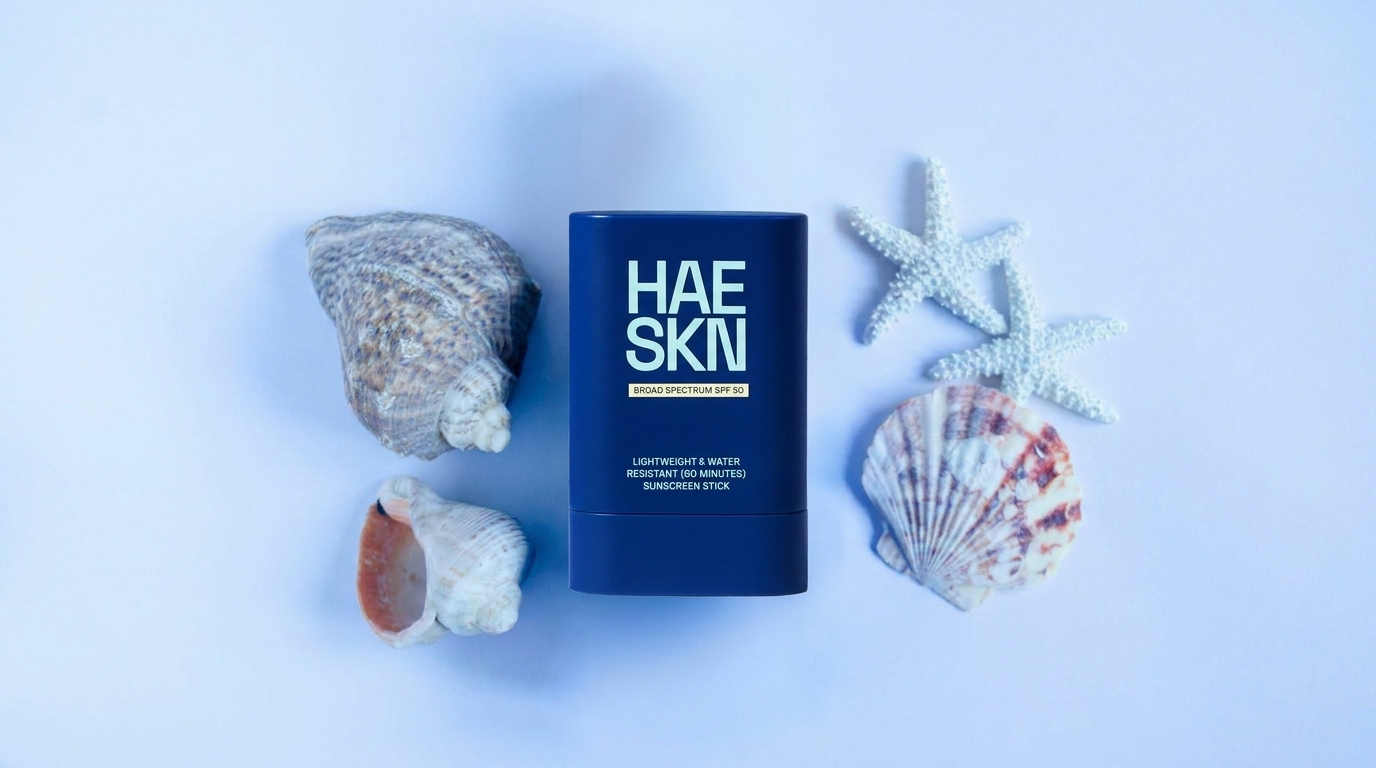
HAESKN's hero product, the HAESKN SPF 50 sunscreen stick, uses a four-filter system reviewed under the FDA's OTC monograph and confirmed by HAESKN's FDA labeling consultant. The active ingredients are:
| Filter | Concentration | What it does |
|---|---|---|
| Homosalate | 9.0% | UVB absorber, stabilizes other filters |
| Octocrylene | 5.0% | UVB absorber, photostabilizer for avobenzone |
| Octisalate | 4.5% | UVB absorber, water-resistance booster |
| Avobenzone | 2.9% | UVA absorber, the workhorse for broad spectrum UVA coverage |
Two things are notable about that list.
First, there is no oxybenzone. Oxybenzone is the chemical filter most commonly cited in the "chemical sunscreens cause harm" narrative, and it is also the filter banned in Hawaii since 2021 because of coral reef toxicity concerns (Surfrider Foundation: Hawaii Reef-Safe Sunscreen Ban). HAESKN deliberately omitted it from the formula during the development phase.
Second, the four-filter system was paired with K-beauty skincare actives uncommon in U.S. sport SPF: ceramide NP for barrier support, Panax ginseng root extract, olive fruit oil, soybean sterols, rice extract, and shea butter. The active ingredients work as a sunscreen. The supporting matrix is built like a K-beauty serum.
The FDA labeling consultant approved the product to claim Broad Spectrum SPF 50 and Water Resistant (80 minutes), the highest water-resistance class the FDA permits on an OTC sunscreen label.
"We decided to build from the start around UV filters and technology already approved by the FDA. That ensures reliability and safety in the U.S. market, while still prioritizing the texture, feel, and everyday wearability that consumers love about K-beauty suncare."
Eugene Kim, co-founder & Product Lead, HAESKN (ex-Estée Lauder, designer of the dual-chamber Clinique iD flacon)
Performance: where the two systems really differ
Once you set aside the "natural vs. synthetic" framing, the actual differences come down to formulation behavior.
| Attribute | Mineral (ZnO, TiO2) | Chemical (avobenzone + octisalate + etc.) |
|---|---|---|
| Mechanism | Reflects, scatters, absorbs UV | Absorbs UV, converts to heat |
| White cast on dark skin | Often visible | Usually invisible |
| Texture | Thicker, draggy | Lighter, fast-spreading |
| Reapplication over makeup | Harder | Easier |
| Water and sweat resistance | Good in stable films | Often superior in 80-minute testing |
| Irritation risk on reactive skin | Lower | Slightly higher, formula-dependent |
| Photostability | Strong | Strong when properly stabilized (e.g., octocrylene + avobenzone) |
A 2025 review in the African Journal of Scientific Research found chemical filters delivered broad-spectrum efficacy comparable to mineral filters in lab conditions, with mineral slightly more persistent after extended water immersion, but only when the mineral formula was at high enough concentration to avoid micronization gaps (AJOSR: Efficacy, Persistence and Safety of Inorganic vs. Organic Sunscreens, 2025).
The catch is real-world use. Mineral formulas that feel heavy get under-applied, and under-applied sunscreen, below the 2 mg/cm² used in SPF testing, delivers a fraction of the labeled SPF (Stanford Medicine: Sunscreen Fact and Fiction).
"The biggest predictor of real protection isn't the filter system. It's whether the person reapplies. A chemical formula they actually like beats a mineral one sitting in the drawer."
Dr. Heather Rogers, board-certified dermatologist, quoted in NPR's 2024 coverage of sunscreen misinformation.
When mineral makes sense
Mineral filters earn their place in a few specific scenarios:
- Infants under 6 months. Pediatricians typically recommend shade and clothing first, with mineral SPF as the only option if exposure can't be avoided.
- Post-procedure skin. After laser, chemical peel, or microneedling, the barrier is compromised and filter absorption increases. Mineral sits on top and is the dermatologist default for 7–14 days post-procedure.
- Highly reactive or rosacea-prone skin. Zinc oxide can be soothing, and some chemical filters trigger contact dermatitis in a minority of users.
- Pregnancy preference. There is no human evidence of harm from chemical filters during pregnancy, but many OB-GYNs default-recommend mineral on a precautionary basis.
The right tool for the job is sometimes zinc oxide — so a clinical mineral formula is the better pick for the scenarios above. HAESKN's lineup currently focuses on the chemical-filter SPF 50 stick, which covers daily-wear, sport, and deeper-skin-tone use cases for the rest of the population.
When chemical makes sense
Chemical filters are the right choice for most daily wear and almost all sports use:
- Athletes and active outdoor use. Lighter formulas reapply cleanly over sweat. The HAESKN sunscreen stick is built for exactly this case. We cover the runner scenario in our NYC Marathon 2026 race day essentials guide and the court case in Do You Need Sunscreen for Padel?.
- Deeper skin tones. Properly formulated chemical SPF finishes clear without the gray or ashy cast of zinc-heavy mineral formulas. This is the reason Black Girl Sunscreen built an entire brand on chemical filters, and the reason HAESKN designs for every Fitzpatrick type from I to VI.
- Daily wear under makeup. Chemical filters cooperate with foundation and tinted moisturizer in a way most mineral formulas do not.
- Humid climates. Chemical filters generally hold up better in humidity-driven sweat-off conditions.
If your concern is reactive skin rather than performance, look for a chemical formula with avobenzone and octisalate as the lead filters, free of fragrance and denatured alcohol, and patch-test it on the inside of your forearm for 48 hours before applying to your face.
A more honest skin tone conversation
The "mineral is safer" narrative has a side effect that is rarely discussed: it disadvantages consumers with deeper skin tones. Zinc-heavy mineral formulas leave a visible cast on Fitzpatrick types IV–VI, which means daily-wear compliance drops, which means UV exposure goes up. For Latina, Hispanic, and Black athletes who train outdoors, a clear chemical SPF often delivers better real-world protection than a heavy mineral formula they avoid wearing.
This is one of the use cases the HAESKN sunscreen stick was designed for. Clear finish, no white residue on any skin tone, FDA-tested broad spectrum SPF 50 with 80-minute water resistance, and a stick format you can reapply with one hand mid-run or mid-set.
How HAESKN sits in the sport SPF landscape
A practical comparison of stick-format sport sunscreens currently sold in the U.S.:
| Feature | HAESKN SPF 50 Stick | Supergoop (Unseen) | Sun Bum SPF 50 Stick | Shiseido Clear Stick | Freaks of Nature |
|---|---|---|---|---|---|
| Filter system | Chemical (avobenzone + 3 others) | Chemical | Chemical | Chemical | Chemical |
| Clear on dark skin | ✅ | ✅ | ❌ (reports of white cast) | ✅ | ❌ |
| 80-minute water resistance | ✅ | ❌ | ✅ | ✅ | ✅ |
| Reapply over makeup | ✅ | ✅ | ❌ | ❌ | ❌ |
| Stick format for one-hand reapplication | ✅ | ❌ (primer) | ✅ | ✅ | ✅ |
| K-beauty skincare actives in base | ✅ | ❌ | ❌ | ❌ | ❌ |
| FDA monograph compliant | ✅ | ✅ | ✅ | ✅ | ❌ |
| Price | $24 | $38 | ~$15 | $33 | mid-premium |
The pattern is consistent. All the major sport sticks rely on chemical filters because the texture, the clear finish, and the water resistance are what athletes actually need. The differentiator is what brand pairs those filters with, not whether the filters themselves are chemical.
The K-beauty perspective on filters
Korea's Ministry of Food and Drug Safety (MFDS, 식약처) regulates sunscreen as a "functional cosmetic" and has approved roughly 30 UV filters. The FDA has approved 16. Modern filters such as Tinosorb S, Tinosorb M, Uvinul A Plus, and Mexoryl 400 are widely used across Korean and Japanese SPF formulas. They are chemical filters with strong photostability and broad UVA coverage that are not yet legal in the U.S. (MFDS: Cosmetics Approval Process).
This is why Korean daily SPF feels lighter than comparable American formulas. Korean consumers don't perceive "chemical" as a negative term, because Korean formulation culture grew up around performance: under-makeup wear, humid summers, hot subway commutes, not clean beauty marketing.
"The FDA has historically approved only 16 UV filters, with the last new active ingredient added back in 1999, while regions like Europe allow 34 approved filters, often leading to lighter, more cosmetically elegant formulations. Many American brands labeled as 'broad spectrum' may block UVB rays, but they do not meet European standards for shielding carcinogenic UVA rays."
Eugene Kim, HAESKN co-founder, in Personal Care Insights (Jan 2026)
"American sunscreen is stuck in the 90s. We grew up using K-beauty SPF, and we knew the daily-wear gap in the U.S. was a formulation gap, not a consumer-preference gap."
Sherril HwangBo, HAESKN co-founder, on the brand's launch positioning
That gap is starting to close. In October 2024, DSM-Firmenich filed the first application under the FDA's new OMOR pathway for bemotrizinol (BEMT), a next-generation chemical filter widely used in Europe and Asia. A decision is expected by March 2026 (NBC News: FDA Proposal on Bemotrizinol). If approved, it would be the first new sunscreen active in the U.S. monograph in more than two decades. Until then, U.S. brands work with the 16-filter toolbox the FDA permits, and the brands that perform on athletic skin are the ones that build smart chemical-filter systems within that constraint.
How to actually decide
Both filter families are FDA-approved, safe when used as directed, and effective when applied at the right amount and reapplied every two hours or after swimming or sweating. Mineral has a real role in a narrow set of scenarios: babies, post-procedure skin, highly reactive skin. Chemical filters cover the much broader use case of daily wear, athletic use, deeper skin tones, and humid climates. The biggest risk to your skin is not the filter system you pick. It is using too little of either one, or skipping it because a TikTok told you the word "chemical" is scary.
If you want a chemical-filter stick that was built to FDA monograph standards, finishes clear on every skin tone, and was developed by founders who actually run and play padel in the sunscreen they make, the HAESKN sunscreen stick is the product we made for that case.
FAQ
Q: Is chemical sunscreen actually safe?
A: Yes. The FDA regulates chemical filters under the current OTC monograph and continues to allow their sale. The 2019 absorption study triggered a request for more data, not a safety withdrawal. The American Academy of Dermatology, the FDA itself, and Stanford Medicine all confirm there is no evidence that approved chemical filters cause harm in humans when used as directed.
Q: Which is better for dark skin?
A: For most users with deeper skin tones, well-formulated chemical sunscreens are the better daily choice because they finish clear without the gray or ashy cast of zinc-heavy mineral formulas. Brands like Black Girl Sunscreen and HAESKN specifically design for this finish. If you prefer mineral, look for a tinted formula matched to your skin tone.
Q: Which is better for sensitive skin?
A: The AAD generally recommends mineral filters as a starting point for sensitive or rosacea-prone skin because they sit on top of skin and have a lower incidence of contact reactions. However, sensitivity is filter-specific. A low-irritation chemical formula with avobenzone and octisalate may be perfectly fine for many users with sensitive skin. Patch-test first.
Q: Why does Korean sunscreen feel so much lighter than American sunscreen?
A: Korea's MFDS has approved roughly 30 UV filters, including next-generation chemical filters like Tinosorb S and Uvinul A Plus, that are not yet FDA-approved in the U.S. These filters provide strong broad-spectrum coverage at lower concentrations, which allows for lighter, more elegant formulas. American brands working under the FDA monograph have a more limited 16-filter toolbox.
Q: Does HAESKN's sunscreen stick contain oxybenzone?
A: No. The HAESKN SPF 50 sunscreen stick uses avobenzone, homosalate, octisalate, and octocrylene as its active ingredients. Oxybenzone, the filter most commonly associated with safety concerns and the one banned in Hawaii for coral reef toxicity, is intentionally omitted from the formula.
Q: Does mineral sunscreen protect better than chemical sunscreen?
A: No. Protection depends on broad-spectrum coverage, SPF rating, and how much you apply. Lab studies show comparable UV protection between the two filter types when applied at the SPF-test rate of 2 mg/cm². The real-world difference is reapplication. Whatever sunscreen you actually reapply is what protects you.
Frequently asked questions
What is the main takeaway from Mineral vs Chemical Sunscreen: Which Is Actually Better??
Both filter types are FDA-approved and safe. Chemical filters win for daily wear, sports, and dark skin; mineral wins for babies and post-procedure skin.
Who should read Mineral vs Chemical Sunscreen: Which Is Actually Better??
This article is written for HAESKN readers who want practical, source-backed guidance before making a decision or changing their routine.
When was Mineral vs Chemical Sunscreen: Which Is Actually Better? last updated?
Mineral vs Chemical Sunscreen: Which Is Actually Better? was last updated on 2026-07-11.