Sunscreen Filters: What Actually Matters in 2026
The filter on your sunscreen label matters less than you think. What actually protects you: broad spectrum coverage, photostability, and reapplication.
Contents
- The short answer
- What a UV filter is supposed to do
- The "chemical vs mineral" argument is mostly a distraction
- Photostability: the spec that actually matters
- The two things no filter can fix
- What to actually look for (checklist)
- Where formulation comes in
- FAQ
- Do sunscreen filters really not matter?
- Is chemical or mineral sunscreen better?
- Are chemical sunscreen filters safe?
- What does "broad spectrum" actually mean?
- Why does avobenzone need other filters with it?
What Sunscreen Filters Actually Do for Your Skin
By Eugene Kim, Co-founder & Product Lead, HAESKN. Former packaging design lead at Clinique (Estée Lauder Companies). Adjunct professor, Pratt Institute. Formulation reviewed with HAESKN advisor Julio Pina, an award-winning cosmetic chemist.
Published 2026-05-20.
The filter named on your sunscreen label matters less than most people think. What matters more: broad spectrum coverage, whether the formula stays stable in sunlight, and whether you apply enough and reapply on time. A trendy filter applied in a thin single layer protects you worse than a standard filter applied properly and reapplied.
Here is what sunscreen filters actually do, which ones the FDA allows, and why the label argument most shoppers have is the wrong one.
The short answer
Every sunscreen sold legally in the US uses UV filters from the FDA's recognized list. Those filters split into two families. Mineral filters are zinc oxide and titanium dioxide. Chemical filters include avobenzone, octocrylene, homosalate, and octisalate, among others. Both families prevent sunburn and reduce the risk of skin cancer and early skin aging when the product is used as directed.
The filter is the floor, not the ceiling. Above it sits the part nobody prints on the front of the bottle: photostability, texture, and whether the product fits the day you actually have.
What a UV filter is supposed to do
A sunscreen filter has two jobs, because sunlight does two kinds of damage.
UVB rays burn the surface of your skin. UVA rays reach deeper and drive most photoaging: fine lines, loss of firmness, uneven pigment. A sunscreen that handles only UVB leaves the slow damage running. That is why the FDA only lets a product claim it reduces aging and cancer risk, not just sunburn, if it is labeled broad spectrum, meaning the formula passed a test for protection across both UVA and UVB (FDA).
So the first real question is not "chemical or mineral." It is "broad spectrum or not." Check that phrase first. Everything else is secondary.
The "chemical vs mineral" argument is mostly a distraction
Mineral and chemical filters protect skin through slightly different physics. Both absorb UV; mineral filters also scatter a little of it. In practice, both reduce UV damage, and the FDA recognizes both.
A 2021 FDA proposed order did sort the filters. Zinc oxide and titanium dioxide were proposed as generally recognized as safe and effective. The common chemical filters, including avobenzone, octocrylene, homosalate, and octisalate, were placed in a "needs more data" category (FDA). One nuance gets lost in headlines: "additional data requested" is not a finding of harm. Those filters remain legal, remain on shelves, and remain backed by decades of use. Only two older ingredients, PABA and trolamine salicylate, were proposed as not safe and effective.
The differences you actually feel day to day are simpler:
- Mineral can leave a white cast, especially on deeper skin tones.
- Chemical formulas usually go on clearer and feel lighter.
- Mineral is often suggested first for very reactive or rosacea-prone skin.
None of that is about which filter is "better." It is about which one you will wear every single day without complaint. The best filter is the one that does not give you a reason to skip it.
Photostability: the spec that actually matters
Here is what the label argument misses.
Avobenzone is the most common UVA filter in US chemical sunscreens. On its own, it is photo-unstable: it begins to break down in sunlight and can lose a meaningful share of its UVA protection within the first hour of exposure, a limitation documented in reviews of sunscreen filter science (NCBI / PMC). That is a real weakness. The fix is not a rare or exotic filter. The fix is formulation — pairing avobenzone with stabilizing filters such as octocrylene that hold it together so protection lasts through the wear window.
This is ordinary cosmetic chemistry, and it is exactly the detail that separates a well-built sunscreen from a poorly built one using the identical filter list. Two products can print the same four filters on the back and perform very differently, because one was formulated for photostability and the other was not.
HAESKN's formulation advisor, award-winning cosmetic chemist Julio Pina, builds the brand's formulas around that principle: the filter list tells you what is legal, not what performs. The performance lives in how the filters are combined, stabilized, and carried.
The two things no filter can fix
Even a perfectly formulated sunscreen fails at two ordinary moments.
Application amount. Most people apply far less sunscreen than the amount used to certify the SPF on the label. Apply roughly half the tested dose and real-world protection drops sharply. An SPF 50 spread too thin can behave closer to the low teens. The American Academy of Dermatology recommends about one ounce, a shot glass, to cover the body, and a nickel-sized amount for the face (AAD).
Reapplication. The AAD is firm: reapply every two hours, and immediately after sweating or swimming (AAD). No filter on earth corrects for a layer that is eight hours old.
This is where format quietly decides everything. A cream you will reapply at a bathroom mirror is fine. A cream that lives at the bottom of a bag and never comes out is not. The protection you get is the protection you actually apply.
What to actually look for (checklist)
- "Broad spectrum" on the label. Non-negotiable. Skip anything without it.
- SPF 30 minimum; SPF 50 for margin against thin or uneven application.
- A photostable formula. Chemical formulas should pair avobenzone with stabilizers. This is a quality marker worth asking about.
- Water resistant 80 minutes if you sweat or swim.
- A texture you will wear, clear on your skin tone and comfortable under or over makeup.
- A format you will reapply, one you can carry and use without a mirror.
- Dermatologist-tested.
Notice what is not on that list: the specific brand name of the filter. For a properly formulated broad spectrum sunscreen, it does not crack the top five.
Where formulation comes in
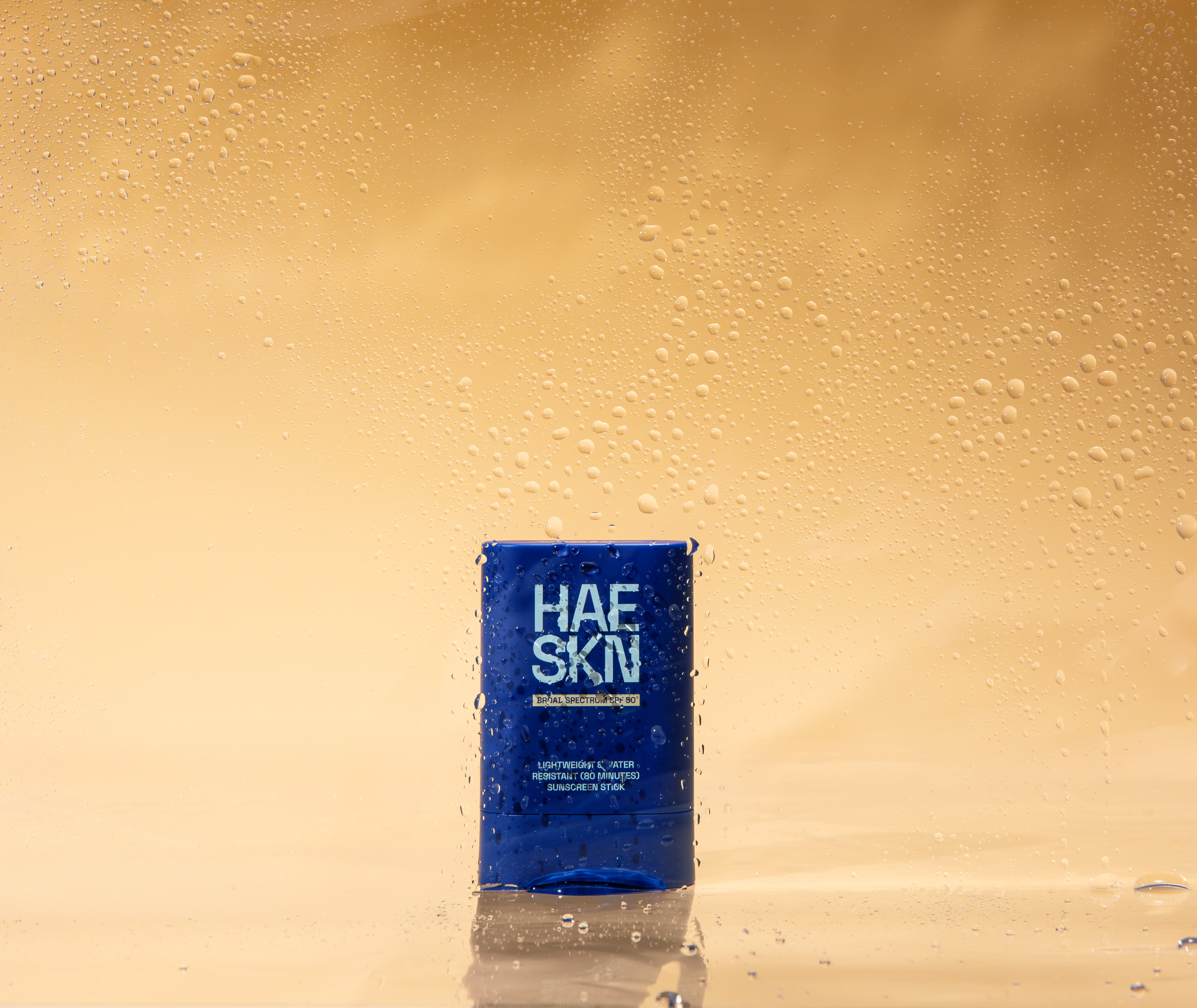
HAESKN's SPF 50 Sun Stick uses the standard, FDA-recognized chemical filter set: avobenzone for UVA, supported by octocrylene, homosalate, and octisalate. No exotic or unapproved ingredients. The work goes into what surrounds that set: a photostable, broad spectrum formula, a lightweight K-beauty texture carrying skincare actives like ceramide and rice extract, a clear finish on every skin tone, and a stick format you can reapply with one hand mid-run or between padel sets.
A short look at how a few US-market SPFs handle filter selection, alphabetized:
| Product | Price | Filter type | Notes |
|---|---|---|---|
| Australian Gold Botanical Tinted Mineral SPF 50 | ~$13 | Mineral (zinc + titanium) | Mass-market mineral with plant-extract positioning; reef-friendly marketing |
| COSRX Aloe Soothing Sun Cream SPF 50+ | ~$20 | Chemical | Korean accessible chemical SPF; aloe-based texture; no oxybenzone |
| Drunk Elephant Umbra Sheer Physical SPF 30 | ~$38 | Mineral (zinc oxide) | Clean-beauty premium mineral; lotion format; designed for over-makeup wear |
| HAESKN SPF 50 Sun Stick | $24 | Chemical (avobenzone + octisalate + homosalate + octocrylene) | Clear on every tone; K-beauty texture with ceramide and rice extract; built for one-handed reapplication; dermatologist tested |
| ISDIN Eryfotona Actinica SPF 50+ | ~$60 | Mineral (zinc oxide) with photolyase | Derm-clinic favorite; adds DNA-repair enzyme; premium price |
| Sun Bum Mineral SPF 50 Face Stick | ~$15 | Mineral (zinc oxide) | Mass-market sport mineral; visible cast on deeper tones |
One honest note on our own product. HAESKN launched in 2024, so we do not have the decade of independent long-term reviews that the incumbents on this list have built. We are transparent about our filter set and our formulation choices because that is the conversation that actually matters — not which filter has the trendiest name.
FAQ
Do sunscreen filters really not matter?
They matter, but less than the marketing around them suggests. Any broad spectrum sunscreen using FDA-recognized filters will protect you if it is photostable and you apply enough. Filter choice affects feel and finish more than it affects whether you are protected. Application amount, reapplication, and formula stability move the needle more.
Is chemical or mineral sunscreen better?
Neither is universally better. Both are FDA-recognized and effective. Mineral can suit very reactive skin and avoids the photostability question; chemical formulas tend to feel lighter and go on clearer, especially on deeper skin tones. Pick the one you will wear daily without skipping.
Are chemical sunscreen filters safe?
The common chemical filters remain legal and widely used. In 2021 the FDA asked for additional data on filters like avobenzone before formally classifying them as generally recognized as safe and effective. That is a data request, not a finding of harm. Only PABA and trolamine salicylate were proposed as not safe and effective.
What does "broad spectrum" actually mean?
It means the formula passed an FDA test showing it protects against both UVA and UVB, not just UVB. Only broad spectrum sunscreens can claim to reduce skin aging and skin cancer risk. If a product does not say "broad spectrum," treat it as sunburn protection only.
Why does avobenzone need other filters with it?
Avobenzone is an effective UVA filter but breaks down in sunlight on its own. Formulators pair it with stabilizers such as octocrylene so it keeps protecting through the wear window. A chemical sunscreen that combines avobenzone with stabilizing filters is a sign of careful formulation.
If you want one built around photostability and easy reapplication, the HAESKN SPF 50 Sun Stick is $24 and ships from the US.
About the authors. Eugene Kim is co-founder and product lead at HAESKN. He spent nearly two decades at Estée Lauder Companies, most recently as packaging design lead at Clinique, and is an adjunct professor at Pratt Institute. HAESKN's formulations are developed with advisor Julio Pina, an award-winning cosmetic chemist. Co-founder Sherril HwangBo, a former design director at LVMH, leads brand and creative.
Sources
- U.S. Food & Drug Administration, "Questions and Answers: FDA posts deemed final order and proposed order for over-the-counter sunscreen" — https://www.fda.gov/drugs/understanding-over-counter-medicines/questions-and-answers-fda-posts-deemed-final-order-and-proposed-order-over-counter-sunscreen
- American Academy of Dermatology, "Sunscreen FAQs" — https://www.aad.org/public/everyday-care/sun-protection/shade-clothing-sunscreen/sunscreen-faqs
- "Modernizing U.S. Sunscreen Regulations: How Newer Filters Can Improve Public Health," NCBI / PMC — https://pmc.ncbi.nlm.nih.gov/articles/PMC12332967/
Frequently asked questions
What is the main takeaway from Sunscreen Filters: What Actually Matters in 2026?
The filter on your sunscreen label matters less than you think. What actually protects you: broad spectrum coverage, photostability, and reapplication.
Who should read Sunscreen Filters: What Actually Matters in 2026?
This article is written for HAESKN readers who want practical, source-backed guidance before making a decision or changing their routine.
When was Sunscreen Filters: What Actually Matters in 2026 last updated?
Sunscreen Filters: What Actually Matters in 2026 was last updated on 2026-07-11.