Why Sunscreen Leaves a White Cast (and How to Avoid It)
Sunscreen leaves a white cast when mineral filters scatter visible light, worst on deeper skin tones. Chemical filters absorb UV and stay clear.
Contents
- The short version
- The chemistry: why mineral filters look white
- Why it's worse on deeper skin tones
- How chemical filters stay clear
- The tint workaround, and where it stops
- What about next-generation filters like bemotrizinol?
- How to avoid a white cast
- FAQ
- Why does my sunscreen turn white or gray after a few minutes?
- Do all mineral sunscreens leave a white cast?
- Is a white cast just cosmetic, or does it mean better protection?
- Are clear Korean sunscreens better at avoiding white cast?
- What sunscreen has no white cast on dark skin?
- The bottom line
What Actually Causes Sunscreen's White Cast
By Julio Pina, HAESKN formulation advisor and award-winning cosmetic chemist. With Eugene Kim, Co-founder & Product Lead, HAESKN (former packaging design lead at Clinique, Estée Lauder Companies), and Sherril HwangBo, Co-founder & Creative Director (former design director at LVMH).
Published 2026-06-08.
Short answer: Sunscreen leaves a white cast when mineral filters, zinc oxide and titanium dioxide, sit on top of the skin and scatter visible light along with UV. Those filters are naturally white and work by reflecting and scattering light to form a physical barrier, so some of that scatter lands in the visible range and reads as a pale or ashy film. It shows up most on deeper skin tones. Chemical filters work the opposite way: they absorb UV and stay clear, which is why a well-built chemical formula avoids the cast entirely.
If you have ever rubbed in an SPF and watched your face go gray in a photo, the filter type is the cause, not how much you applied.
The short version
- White cast comes from mineral filters scattering visible light. Zinc oxide and titanium dioxide are white powders. They block UV by reflecting and scattering it, and some of that scatter is visible.
- It looks worse on deeper skin because a pale film contrasts more against medium and deep tones.
- Chemical filters absorb instead of scatter, so they go on clear. HAESKN uses FDA-approved chemical filters for exactly this reason.
- Tinted formulas hide the cast with iron oxides, but one tint only matches a band of tones, not everyone.
The chemistry: why mineral filters look white
Mineral filters are physical particles. Once spread on skin they form a thin layer that bounces UV away. The catch is that the same optical property that scatters UV also scatters part of the visible spectrum, and visible scatter is what your eye reads as white.
Three formulation variables decide how strong that cast is:
- Particle size. Larger particles scatter more long-wavelength visible light. Micronized and nano-scale particles scatter less of it, which is why modern mineral sunscreens blend better than the chalky versions from a decade ago. They still scatter some.
- Concentration. A higher SPF mineral formula needs more zinc oxide or titanium dioxide. More white particles on the skin means a stronger cast. The FDA recognizes zinc oxide and titanium dioxide as safe and effective UV filters, but it does not make them invisible.
- The base. The emulsion, any tint, and the finish all change how the particles sit and how much light they throw back.
"People blame their technique, but a white cast is physics, not user error," says Julio Pina, HAESKN's formulation advisor and an award-winning cosmetic chemist. "A white mineral particle scatters visible light by design. You can shrink the particle and tune the base to soften it, but if the filter is mineral, some cast is baked in. The clean way around it is to absorb UV instead of scatter it."
Why it's worse on deeper skin tones
The film a mineral sunscreen leaves is roughly the same on everyone. What changes is the contrast. Against fair skin a faint white layer disappears. Against medium and deep skin it reads as gray or ashy.
This is a measurable, documented problem, not a matter of taste. Researchers have even built a standardized method for scoring white cast across diverse skin tones precisely because the cast drives people with richer skin to skip sunscreen, which is the worst outcome for a product whose only job is to be worn. A sunscreen that looks wrong in the mirror does not get reapplied, and reapplication is most of the protection.
For athletes the stakes are practical. A chalky face on a padel court or in a race photo is the visible version of a deeper issue: if the finish bothers you, the bottle stays in the bag.
How chemical filters stay clear
Chemical filters are organic molecules, not particles. Instead of bouncing UV off the surface, they absorb it and release the energy as a small amount of heat. Because they are dissolved into the formula rather than suspended as white solids, they leave no visible scatter and no cast.
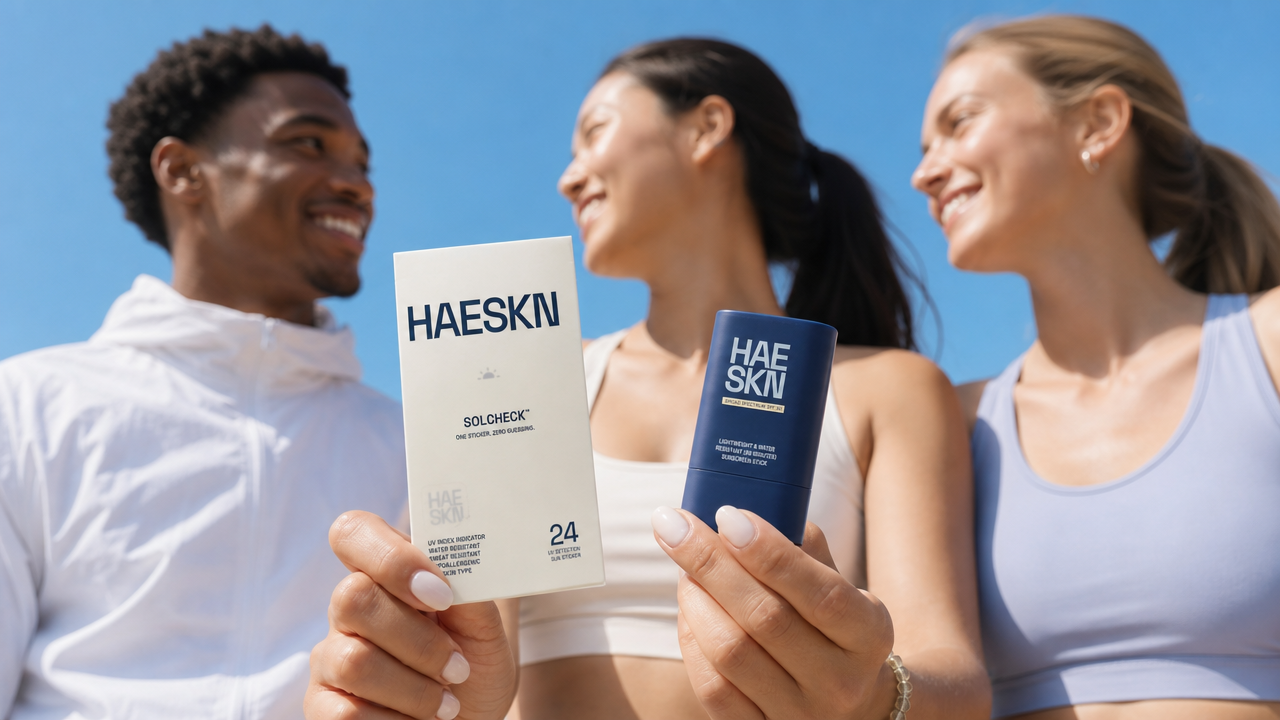
That is the entire reason HAESKN built its stick on FDA-approved chemical filters. A clear chemical system is what lets the HAESKN SPF 50 Sun Stick go on invisible across every skin tone, with the lightweight finish a stick needs for mid-activity reapplication. For a fuller side-by-side on the two filter families, Mineral vs Chemical Sunscreen: Which Is Actually Better? covers the trade-offs beyond appearance.
The honest caveat: chemical filters are not automatically better at protection. Both families are FDA-permitted and effective when used as directed. The white cast question is specifically about finish, and on finish, clear chemical filters win.
The tint workaround, and where it stops
The common fix for mineral white cast is a tint. Formulators add iron oxides, the same pigments used in foundation, to cancel the pale film with a skin-toned color. Tinted mineral sunscreens have a real bonus: iron oxides also block visible and blue light, which helps with hyperpigmentation and melasma that pure UV filters miss.
The limit is matching. A single tint suits a band of tones. Go lighter or deeper than that band and the tint either disappears or turns muddy. Tinting solves the cast for some people and creates a color-match problem for others. A clear chemical formula sidesteps the whole question because there is no pigment to match.
What about next-generation filters like bemotrizinol?
This is where it gets interesting, and where a lot of online advice is out of date for US shoppers.
Newer filters such as bemotrizinol (sold globally as Tinosorb S) are organic, broad-spectrum, very photostable, and cosmetically clear. They are widely used in Korean and European sunscreens and are a big reason those products feel so elegant.
Here is the update that matters: until recently these filters were not approved for sunscreens sold in the United States. That changed on June 9, 2026, when the FDA approved bemotrizinol, effective August 9, 2026. It is the first new US sunscreen filter in about 20 years, and US products using it will roll out gradually after that date. Its relative, bisoctrizole (Tinosorb M), is still not approved. We break down what the approval means in What Bemotrizinol Actually Changes.
That regulatory timeline is part of why HAESKN's approach is what it is. The brand is US-made and FDA-compliant, delivering a clear, no-cast finish using approved chemical filters today, and as newer filters like bemotrizinol come online for US production the toolkit only gets better. If you want the longer version of the US-versus-Korea filter question, Are Korean Sunscreens FDA Approved? An Athlete's Guide and Are Sunscreen Filters Safe? A 2026 FDA Guide both go deeper.
How to avoid a white cast
A short checklist:
- Choose a clear chemical formula if a no-cast finish is your priority. It is the most reliable route across all skin tones.
- If you want mineral, go tinted, and match the tint to your skin in store light before you commit.
- Test on your jaw, not your hand. The back of your hand is a different tone from your face. Swipe a stripe along the jawline and check it in natural light.
- Mind the dose. A cast often looks worse because someone piled on extra product to feel covered. With a clear chemical stick you get full coverage without the buildup. More on what separates one filter from another is in Sunscreen Filters: What Actually Matters in 2026.
- Watch the flash. Some mineral and tinted formulas look fine in person but flash back white in photos. If you are on camera, a clear chemical finish is the safe call.
FAQ
Why does my sunscreen turn white or gray after a few minutes?
That is mineral filter scatter setting on the surface as the base dries. Zinc oxide and titanium dioxide are white and reflect visible light, and the effect gets more obvious as the carrier evaporates. A clear chemical formula will not do this.
Do all mineral sunscreens leave a white cast?
Most leave some, though micronized particles and tints reduce it. The cast is strongest at high mineral concentrations and most visible on deeper skin. Chemical filters avoid it because they absorb UV rather than scatter it.
Is a white cast just cosmetic, or does it mean better protection?
Purely cosmetic. The cast is visible light scatter, not a sign of stronger UV defense. Both mineral and chemical filters are FDA-permitted and effective when applied correctly.
Are clear Korean sunscreens better at avoiding white cast?
Many use newer organic filters that are clear and photostable, which is why they feel elegant. Those filters were not approved for US sunscreens until the FDA approved bemotrizinol on June 9, 2026, effective that August, with US products rolling out gradually after. For now, a US-made, FDA-compliant product gets a clear finish using the chemical filters already approved.
What sunscreen has no white cast on dark skin?
A clear chemical formula is the most dependable choice across deep tones, since there is no white particle and no tint to match. HAESKN's stick was built on FDA-approved chemical filters for that reason.
The bottom line
White cast is not a quality problem or a technique problem. It is the optical signature of mineral filters scattering visible light, and it shows up most on the skin tones the beauty industry served last. You avoid it by changing the chemistry, not by rubbing harder.
- Mineral filters scatter visible light. That scatter is the cast.
- Deeper skin shows it more, which is a compliance problem, not a vanity one.
- Chemical filters absorb UV and stay clear. That is the clean fix, and it is what HAESKN chose.
If you want a clear, no-cast SPF that disappears on every tone and reapplies in five seconds, the HAESKN SPF 50 Sun Stick is $24, FDA-compliant, and ships from the US.
About the authors. Julio Pina is HAESKN's formulation advisor, an award-winning cosmetic chemist and formulator. Eugene Kim is co-founder and product lead at HAESKN, formerly packaging design lead at Clinique (Estée Lauder Companies) and an adjunct professor at Pratt Institute. Sherril HwangBo is co-founder and creative director, former design director at LVMH (Moët Hennessy, DFS) and Ralph Lauren. HAESKN is US-manufactured and FDA-compliant.
Sources
- PMC / medRxiv, "A standardized scoring method for measuring white cast of mineral sunscreens across diverse skin tones": https://www.ncbi.nlm.nih.gov/pmc/articles/PMC12380271/
- FDA, "Sunscreen: How to Help Protect Your Skin from the Sun": https://www.fda.gov/drugs/understanding-over-counter-medicines/sunscreen-how-help-protect-your-skin-sun
- American Academy of Dermatology, "Sunscreen FAQs": https://www.aad.org/public/everyday-care/sun-protection/shade-clothing-sunscreen/sunscreen-faqs
- Wikipedia, "Bemotrizinol" (Tinosorb S): https://en.wikipedia.org/wiki/Bemotrizinol
Frequently asked questions
What is the main takeaway from Why Sunscreen Leaves a White Cast (and How to Avoid It)?
Sunscreen leaves a white cast when mineral filters scatter visible light, worst on deeper skin tones. Chemical filters absorb UV and stay clear.
Who should read Why Sunscreen Leaves a White Cast (and How to Avoid It)?
This article is written for HAESKN readers who want practical, source-backed guidance before making a decision or changing their routine.
When was Why Sunscreen Leaves a White Cast (and How to Avoid It) last updated?
Why Sunscreen Leaves a White Cast (and How to Avoid It) was last updated on 2026-06-18.